Showing posts with label event. Show all posts

Thursday, December 23, 2010

Happy First Birthday

Because everyone has a birthday, I want to wish my Blog one too. Happy Birthday, PreeOccupied.

IMG_3756

It was exactly a year ago when on a cold December day I took my camera, got some pictures clicking and posted here. It has been a long, relishing journey since then. No looking back and definitely no end to all my talking! And thankfully they haven't all been monologues.

A full year later, I sit back and feel privileged that I know  you. You show you care for the work I do by leaving your little note of appreciation and suggestion. Sometimes you correct me, other times you even come back and tell me you have tried one of my recipes, or just drop by to say a Hi. You make me feel I have achieved something precious. And then I hunger for more. And just then someone entrusts me with one their family recipes. It truly becomes my honor to not let you down.

IMG_3753

At age one, I am just about beginning to crawl, wobble and reach out to so many of you who have become part of my everyday life. Not one, but hundreds of you who have shared and cared with me and continue to do so.

You make my everyday fun and something to look forward to. So please celebrate with me and have a slice of this trifle dessert I made to mark my first year of Blogging. You may get a teeny little share of it, but you know you have a big chunk of my heart already.

IMG_3757 No birthday is complete without return gifts. And I hate flouting traditions. So I made this wannabe-Madhubani painting specially as a return gift for you.

IMG_3808Join my birthday party at PreeOccupied and share your views and opinions on improving my Blog space, recipe suggestions, or anything you think needs a facelift here.

Here is how you can have my maiden Madhubani painting!

  • Follow this Blog (via Google Friend Connect or NetworkedBlogs)
  • Like my page on Facebook, click on Suggest to Friends, and invite your friends on Facebook to join PreeOccupied
  • Four comments per person will be allowed. Do not forget to leave your email and a separate comment for each entry
  • Blog or Tweet about what you like about PreeOccupied
  • This gift can be taken by anybody from anywhere in the world
  • I will choose the person who takes this painting home through random.org at the end of day (EST) on January 15, 2011

Thank you all once again for being part of my journey of Blogging. I look forward to another year of cooking adventures with you all.

Lots of love.

Affectionately yours,

Pree.

P.S. Here is how I made the Trifle following Jamie’s recipe.

Sunday, December 12, 2010

We Have a Winner!

…for the $35 gift certificate for CSN Stores. image
Celeste of Florida, USA is the lucky person.  
 Celeste  Celeste, I do have your email, and I am going to mail you the details about your $35 CSN gift certificate right away.

Thank you everyone for participating.

Thursday, November 25, 2010

First CSN Giveaway, Just in Time for the Holidays

Win a $35 Gift Certificate to CSN Stores!

CSN Giveaway I was contacted by the CSN Promo Team some time ago for a product review or a giveaway for the readers in the United States and Canada. Its Thanksgiving today in the US. It also means that the BIG Holidays are just around the corner.

I’d like to use this giveaway opportunity from CSN Stores to say my THANK YOU to all the readers and well-wishers of PreeOccupied.

CSN Stores have a ton of items, from Modern Bedding, Coffee and Tea Serving Accessories, Kids and Baby Products, Kitchen Appliances to even Art and Home Dècor. Visit their site and browse through some of their great products.

Its simple to participate in this CSN Giveaway. Here are some ground rules:

  1. You will have to be a resident of US or Canada. Residents of other countries may enter for someone in the US/Canada. Please mention who you are entering for
  2. Visit CSN Stores and comment here about an item you like from there
  3. Let me know what you like or don’t like about this Blog
  4. Follow this Blog (via Google Friend Connect or NetworkedBlogs)
  5. Like my page on Facebook, Tweet or Blog about this giveaway
  6. Four entries per person will be allowed. Don't forget to LEAVE Your EMAIL and A SEPARATE COMMENT for each entry.

The deadline for entry is Sunday, December 12, 2010.  I will choose the winner for this $35 CSN Giveaway using random.org.

*PreeOccupied did not receive any monetary compensation for this post. This giveaway has been funded by CSN.com, and is entirely for the benefit of my Blog’s readers.

**All photographs in this post are © CSN Stores.

Thursday, October 14, 2010

Beyond Five Days of Durga Puja: Maha Round Up

I sit here far, far away from the hub of that one festival I geared up for at least a month ago when I was growing up. Now I am chasing memories, sometimes falling head over heels, getting up again, swallowing that lump in my throat, which I’d like to think of as kissing tonsils.

In between re-playing my own nostalgia and curbing an aching longing to participate in the five days of fun, I sought from the Blog and Facebook world, people like you and me to share their own memories, family recipes, photographs and live commentary on Durga Puja. I was overwhelmed and humbled by the response. 

All good things must be shared. So share I will. I ask you to sit back, sip on your aromatic chai or that silken whiskey-on-the-rocks, close your eyes and be beamed up or down, above and Beyond Five Days of Durga Puja

So put your hands together for the youngest (just four and a half!) and the most talented Little Miss Ellora Filiplic’s Durga drawing. Elly, as she is lovingly called lives in Alberta, Canada with her family. Her Grandmum thinks Elly left Asura out because it was too gory for her sensibilities, but retained a happy-looking Singha (Lion).

Image (2)


My Pujo Journal IMG_0196And surprisingly, we never missed it-all the big pandals, all those hopping around all night long which our cousins gave vivid descriptions of. Well, maybe Ma missed it. Read more…

Pujor Gondho Eshechhe. Durga Puja's in the AirDSC00286I had heard  his stories of how he would recite the prayers in Pujos in England where there was no priest. With a fellow doctor, a Brahmin, mouthing my dad's mantras in front of the Goddess. Read more…

A Bou from Delhi
slide1473 To the extreme relief of a north Indian girl who had spent last 25 years of her life refraining from non vegetarian food during Navratras, my MIL told me that vegetarian meals are eaten on shoshti. Read more…

Navratra
I remember waiting impatiently for the gulab jamuns and dahi badas that my mom made, not to forget the parathas stuffed with chana daal. One of my maternal aunts made coconut ladoos just for me. Read more…

Shorshe Maach/Fish in Mustard-Chili Sauce
Shorshe-Maach-1-465x620I don’t even know if I miss it anymore in that severe heartache kind of way. The memories are sweet and calm. Everything seems very very far away, a trance… slowly fading in to past as if it never happened. Read more… 

বাজল তোমার আলোর বেণু...মাতলো রে ভুবণ...IMG_6486.2 Nil akashe jokhon sada megher bhela, nodir chore jokhon 'Rupoli Bali' chikchik korche...Kash fuler bon jhokhon anonde matoyara…'Kumartuli-r' karigor-ra jokhon byasto 'thakur gorte' tokhon shuru hoto 'Pujor Bajar'. Read more…

Mahalaya…Khichudi, Dalma and Kheeri
IMG_7754-1I heard Padma fill the bucket with water and splash it. Her glass bangles moved in rhythm to make a nice jingle as she swept the courtyard. Gopal Bhai the 'Phul wala' was also early. Read more… 

There is Something About Pujo
With the silvery stalks of slender ‘Kashful’ swaying to the changing winds, the air would be heavy with the ‘Pujo pujo gondho’. Read more…

A Day, A World…
Every year this day of Mahalaya makes me cry. I miss my friends, my teachers, my parents and the enchanting Anandamela. I am not sure when again I would be able to visit the fair. Read more…

Navratri Nostalgia
4544913099_62914cf547_o And then to balance the sweetness there was sundal...tangy, spiced chick peas seasoned with mustard and garnished with grated coconut. Read more…

Mega Feast on Mahalaya Day
IMG_0900_thumb[3] Some of us would recall the pre-dawn wake-up calls from our parents and grand-parents on this day to tune into the enchanting voice of the Late Birendra Krisna Bhadra. Read more…

Durga Puja
IMG_8208 copy Any celebration for me is incomplete without a dedicated shrine… Be it Diwali or Christmas, I always have a dedicated shrine made for the festivities. And of course you know… that candles and lotus (new addition) make me happy!! Read more…

Probasinir Pujo
n580423346_911127_5658 It was Shashthi, on that day of Sharat in 1998 and a pot of  Shiuli was in full bloom in Roy Mashima’s balcony next door. It was Durga Pujo in the Bong ghetto, in Chittaranjan Park but it was business as usual for the rest of the city. Read more…

Shubho Mahalaya with Luchi and Alu Charchari
luchi.tarkari This mahalaya am here in Bangalore and not going home, but still the feeling of puja with the clear autumn sky, with a sole shiuli plant at my neighbour’s have caught me, have wrapped me in its arm. I yearn to go back and touch those times for one more time. Read more…

Beyond Five Days of Durga PoojaHL-3 Being married to a Bengali has several perks. Awesome Bengali  food, getting to share their love for literature & music are just some of them. But the one that stands out for me is definitely being part of Durga  Pooja. Read more…

Kaleidoscopic Memories From Past
30275_126551064032832_118032338218038_192142_122210_n Then getting on with her friends together for a quick session of Puchka outside Pujo Mandap. And then realizing that your first crush has just come up with his gang of friends and is awed at looking at you with that pretty saree. Read more…

The Magnificent Durga Puja
Image195The nights become spectacular because the whole city is illuminated with colorful lights. Thousands throng the streets hopping from one pandal to another. Since driving becomes a nightmare traveling by foot sounds more sensible thing. Read more…

Kickstarting the Festivities DSCN1848 The university had a very large Bengali community which meant that Durga Pujo was celebrated with aplomb!! And I would tag along with her to the main extravaganza to eat my fill of delicious Bengali food. Read more…

Khi(n)chudi Karaishuti Diye and Thoughts of Durga Puja
DSC03377 The tailor came and sat stitching away our Puja dresses...at least 5 new dresses for the five days starting from Sashthi, to Saptami, to Ashtami, moving on to Navami and then the last day of the Pujas, the great Bijoya Dashami. Read more…

Celebrating Festival Moments With Malai Kulfipista malai kulfi (1)My mom would prepare some traditional stuff like obattu(sweet channa dal stuffed roti), pulihara (tamarind rice),dahi wada (curd dumplings), besan ke laddu (chickpea flour sweet balls), kara posa (spicy fried snack), gulab jamun and so many other stuff for distribution to all neighbours, friends and relatives to celebrate this festival. Read more…

Ma Durga Calling
On the day, the first coat of water color appeared on the idols, we two stood for minutes passing into hours – as the potters were bringing life to earthen shapes. Read more…

Of Dolls and BeachesIMG_2692 (1) Golu is an artistic arrangement of dolls in odd numbered steps with increasing levels of divinity in the dolls as you traverse up the steps. Read more…

Dahi Bara and Aloo dum and Ghuguni
dahi-bara-chat Durga Puja times brings nostalgia and somehow food figures high on my list of happy times during puja. While I cannot claim this dahi bara, aloo dum or ghughuni is authentic, it does get me to a happy mood! Read more…

You would have also read the individual posts already published for this event:

If you have reached this far, you know what nostalgia is all about. Hope all five days of your Durga Puja and beyond are filled with warmth, happiness and care.

Asche bochor abaar dekha hobe (we will meet again in the coming year), in the words of my great Grandmother – Dugga Dugga.

pree

Tuesday, October 12, 2010

Beyond Five Days of Durga Puja: In the Name of the Goddess

(Shaili Thakur of Chandigrah, India, weaves memories of Durga Puja celebrations in her village in Madhubani. Read a vivid description of Kumari Bhojan, Bali Pradaan and the forgotten Ram Lila.)

When I was little, Durga Pooja meant going to my ancestral village for one long, blissful week. Our village Sarbaseema fell in Madhubani district in Northern Bihar, part of the
ancient erstwhile kingdom of Mithila. It had been home to several generations of Shrotriya Brahmins, the most orthodox and conservative of all Maithil Brahmins (and by
extension, also the most snobbish!!). The very sight of our sprawling two-storey house in the village filled our hearts with joy and anticipation as we arrived from Patna after a six- hour bus trip.

Early next morning we were awakened by our Grandmother who handed each of us children a small phooldaala and asked us to bring flowers for the morning pooja. It was a task we relished--our village had a profusion of flowering herbs, shrubs and trees. We knew, by experience, which flowers were not supposed to be offered and which ones had a high offer-value, so to speak.

P1040741 Leading the latter group was the flower Harsingar with its delicately sweet, heady smell. You were, of course, not supposed to deliberately smell the flowers as that would render them un-offerable. The Harsingar flowers were so special, our grandmother said, that they were the only flowers that could be offered to Ma Durga even after they had fallen off the tree--provided they had fallen onto grass. Another special flower was the Tharkamal (literally the land-lotus). Its striking large flowers bloomed a pristine white in the morning but as the day wore on, they changed colour to a deeper and deeper shade of pink, so that at the end of the day they almost appeared purple. They even find mention in the Ramayan, we were told. Rama was struck by their beauty while he was talking a walk in Raja Janak's palace gardens in Janakpur, where he had gone to marry Janak's daughter Sita. It is quite probable that these flowers are endemic to the Mithila region--I do not remember seeing them in Patna and certainly not outside Bihar.

Soon afterwards, all the little girls in the village, yours truly included, were bathed and dressed in new clothes--it was time for Kumari-Bhojan. As our male cousins watched
enviously , the ladies of the village washed our feet, placed a sindoor 'thop' on our foreheads and touched our feet with great reverence. We squirmed and giggled, unused to
such deferential and unwavering attention.
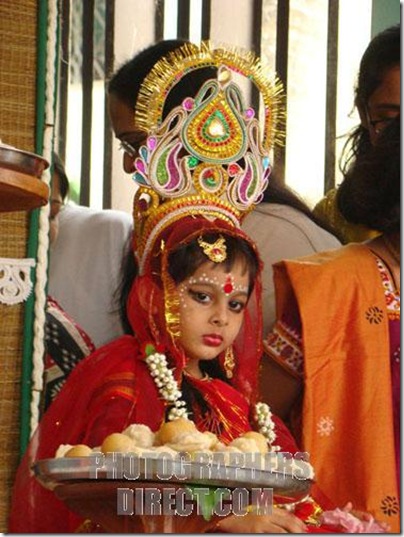
Kumari Puja, Bangladesh We were then made to sit on decorated wooden planks and offered payas (kheer), puas and sweets on washed plantain leaves—a meal fit for the Gods...and Goddesses! You were supposed to eat all you could—the ladies looked very pleased when somebody asked for a second helping. I asked for several helpings for this very reason....well, okay,I do have a huge sweet tooth, and if it pleased my aunts to watch me attack the payas with gusto, who was I to deny them their happiness!! After we were done eating, we were handed crisp 20 rupee notes along with large chunks of betel nuts. We promptly donated the betel nut pieces to those who liked to chew them, but nothing could make us part with our money. We kept them in our fists so that they soon became crumpled and soggy--quite often they slipped out of our tiny fists and got lost, causing a lot of heartache!

Later in the morning, the person entrusted with performing the Pooja at the Durga temple in our village (called the Durga Sthaan), invariably a relative, came and sprinkled holy
water with flowers over the heads of all children, one by one, every time chanting the shloka which enumerates the nine names of Ma Durga:

Jayanti Mangala Kali Bhadrakali Kapalini
Durga Kshama Shiva Dhratri swaha swadha namostute

I've known this shloka by heart for as long as I remember, having heard it repeated countless number of times since I was a baby.

It was then time for the Bali-Pradaan (holy sacrifice), and all the men and children proceeded to the Durga Sthaan to watch. The women wisely stayed behind at home. It
was the only part of the Pooja that I did not quite like. I found it too disturbing and gory. Wincing or grimacing was to be avoided, we were told, as that might invite the Goddess's wrath. Moreover anyone who looked the slightest bit queasy was ribbed by the boys and dubbed a weakling. So I put on a brave face and tried to look nonchalant even as my heart skipped a beat when the blade came down and decapitated the bleating goat.

Everyone returned home after the bali-pradaan, and soon portions of the prasad meat was delivered to each home and cooked the traditional way, sans onions and garlic. Here I will digress a little to shed light on the food habits of my people. The Maithils, cutting across sects and sub-castes, share a food code that might appear rather intriguing to the
outsider: onions, garlic, eggs and chicken were a strict no-no, while fish was not just okay, it was actually considered very auspicious--the first thing a newly wed daughter-in-
law gets to cook in her in-laws' home is fish curry!
decoration-pattern-design-beautiful-photo

The only mutton that was consumed was of the prasad variety, during Durga-Pooja. So our fish-loving people took a break and consumed traditional mutton curry for the last four days of the Pooja. While these food taboos about onions, garlic, eggs, chicken and halaal meat have ceased to hold for quite some time now, its still fairly common to find people of older generations who observe all of these to this day. Even the newer generations observe them for a 'bhoj' on a special occasion-- a marriage or a thread ceremony.

I must now return to what prompted this digression--the prasad meat. Did I tell you that I hated to watch the 'bali-pradaan'? Be that as it might, I certainly loved the rich, spicy mutton curry that was made out of it--positively divine. A hearty lunch was followed by a blissful siesta--by this time even the kids were tired enough to pay heed to their mothers and went to take a nap without giving any trouble.

Nap-time was over all too soon, however, for the most happening part of the day was fast approaching. Everyone put on their best dress and made way to the Durga-Sthaan again, this time accompanied by the ladies too--my mother, grandmother, aunts and grandaunts, all in glittering sarees, their heads demurely covered.
durgapuja1 It was time for the evening aarti, which began just as dusk fell. The temple reverberated with chants of 'Namantram Noyantram' accompanied with the rather raucous sounds of conch shells and brass bells.

A small distance away from the temple was a moderately sized open air 'auditorium', if at all it could be called that. It comprised of a big concrete stage with a couple of ante-rooms and a green room too. The large open field in front of the stage was cordoned off with bamboo barricades and a pandaal erected over it, with a partition down its middle, in
effect making it two pandaals in one--one for the women and the other for the men. (Downright retrogressive, I know, but then I am trying to tell it like it was...it might still be just so for all I know,given how resistant to change we are.) And what was all this for? Well, an event that was eagerly awaited by one and all--for four days, Shashthi, Saptami, Ashtami and Navami, the men of the village painstakingly produced, directed and staged four different plays. The plays were sometimes in Hindi but mostly in Maithili—Hindi scripts were translated into Maithili by one of my granduncles, so a play was staged in Hindi only if there was a constraint of time. Untouched yet by notions of linguistic chauvinism, I liked the Hindi plays better,for the Maithili ones often used a rather archaic and stilted version of the language which I sometimes found difficult to follow. What I did follow and marvel at open-mouthed was the transformation of my uncles, cousins (and some enthusiastic granduncles too) into out-of-the-world characters on stage, delivering dialogues with aplomb, now laughing and now crying real tears.

Finding suitable men for the female characters was a tall order--the person had to be petite, not taller than the male characters, not too hairy, not too dark and with soft
features. Since only a very few of my father's young cousins fitted the bill, they were in heavy demand and had a role to play on each of the four days. But they happened to be blessed with robust, manly voices and it was rather amusing to hear a pretty Sita, Radha or some such lady speak in a booming baritone!

10022824-md The garments worn by the characters were remarkably good, given that the organisers did not have as large a collection of dresses as they would have liked--improvisation was the order of the day and I was
amazed by their eye for detail and sheer zeal. The plays dealt with a wide variety of topics--many based upon one or the other of the Hindu epics and folk-stories and a few
even dealing with contemporary subjects. I even remember a play based on Alexander's conquest of India and how a court-dancer in King Porus's court tried to stab Alexander
with a knife hidden in the folds of her clothes while dancing for him. Alexander fell head over heels in love with this dancer, the play had us believe, and ultimately retreated from India to honour her request.The uncle of mine who played the courtesan went on to become a physician, and I do not suppose his patients can imagine in their wildest dreams their doctor playing a courtesan on stage, complete with lehnga-chunni, jewelry, a wig and coquettish mannerisms to boot!

sind-104-ram_lila-stack My brother and male cousins often got to play bit-parts--no such luck for us girls, of course. In a play based on Raja Harishchandra's story, there was this two-minute scene
about the Raja being alone in a cremation ground and finding himself besieged by jumping and howling ghosts. The boys were to play the ghosts. We were taken aback by the sight of them on stage--their faces painted black and red and white streaks all over their bodies, wearing nothing but tiny loincloths. Amidst all the jumping, one of my cousin's loincloth fell down, and what was worse, unmindful of the disaster that had just struck him, he went right on blithely. Well, let's just say we have still not stopped teasing
him. Every time an incident of wardrobe malfunction hits the headlines, I imagine him squirming in his seat somewhere, remembering his very own wardrobe malfunction!

We returned home late at night and went to sleep right away, barely able to wait for the next day. After all, tomorrow was not just another day, it was another day of the Durga Pooja in our village!

(This post is part of the event at PreeOccupied, Beyond Five Days of Durga Puja.)

Sunday, October 10, 2010

Beyond Five Days of Durga Puja: Dhunuchi, Dhak and Down Memory Lane

(The author of this post, Srirupa Gupta of Pune, India describes herself as a harried mom, foodie and Hindi movie junkie. Srirupa recollects Durga Puja celebrations from Himachal to the USA.)

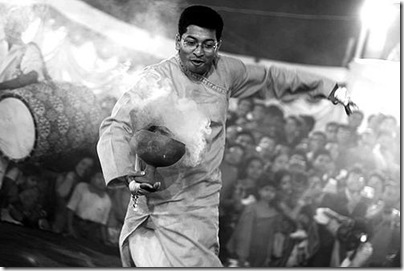
My earliest recollection of Durga Pujo is of attending a Dhunuchi Naach competition in Dalhousie, Himachal Pradesh (circa 1977-78). It seemed like the men were almost floating with the beat of the dhak their feet hardly ever touching the ground. The atmosphere was electric and everyone
gathered around the contestants cheered them on with the Durga murti as a backdrop. The whole place was smoky but smelled divine.

My father being with the Indian Air Force, I got to spend pujos at the places he was posted. My most memorable ones were in Mount Abu, Rajasthan (1986-1989), where the Air Force Station held the solitary pujo in town. The preparations usually began with the arrival of the murtikars
from Kumartuli. The organisers had earlier tried getting murtis from other places but they would often reach damaged or without Karthik and Ganesh!

On this particular year (1988), after the murtis were made about one month ahead and carefully put into storage, it rained incessantly. So when the store was opened about two days ahead of the pujos there was a lush growth of grass all over Ma Durga and her family. My mum armed with
my poster colours ran for damage; hair re-done, Ma and children given a makeover! My mom would talk about how her hands shook while painting Ma’s face: mere mortals don’t really do that!

I came face to face with the big fat Kolkata pujo in 1990 when we moved to Kolkata. It was a heady experience for a rookie like me. I had seen big pujos at Delhi, but hey, this was something else and how!

new 2019 It was like the city had suddenly woken up to revelry: the smell of dhuno, montro floating through the microphone, dhak beats and pujo songs. Lots of lights, people on the streets through the night dressed in their pujo best; the hoi-choi, puchkawalas, roll walas and biriyani shops doing roaring business even at two in the morning.

DSC05774 Nobomis were reserved for visiting the award-winning pandals with extended family and friends.

One could see the fashion trends of the year. 1990 was the year of Maine Pyar Kiya salwar suits, while 2000 was the year of the Anaconda saree (why so named is a mystery) a sure-fire pujo hit as I saw over 60 of them in one night! Amazing decorations calling for a Wow! Like the beautiful Dilwara re-created and use of unusual things for making the pandals and, what were they thinking? for a ghunter pandal bejeweled with a ghunter chandelier which reeked for miles.

I briefly stayed at the US, where I got to see another flavour of pujo. Conveniently tucked on a weekend, it looked like a biye bari where everyone was in their fineries with amazing array of jewelry and designer wear.

Durga2009_9 (1) Families putting up cultural shows, prominent artists performing, khichudi bhog with labra and stalls of all tings Bangali: misti, saree, music and food. It didn’t feel so far away from home after all.

Pujos are moments of shared joy: of precious memories of walking into a pandal with my parents to see what seemed enormous murtis at age five, fretting over new dresses over the teenage years, hanging out with friends and now walking with my children hand in hand, sharing the joy of
seeing Ma Durga in all her splendour all over again.

(This post is part of the event at PreeOccupied, Beyond Five Days of Durga Puja.)

Saturday, October 09, 2010

Beyond Five Days of Durga Puja: That Fever Pitch Fervour

(Prof. Shanker Dutt of Patna, Bihar discusses the visible socio-cultural changes and why he looks forward to Durga Puja.)

While the fervour of Durga pujo is typically associated with Bengal, its importance in Bihar is substantial. The veneration of the mother goddess is particularly fever-pitch from Saptami to Dashami when the blue skies with fleecy white clouds and an early morning nip in the air combines with the aroma of incense and the sounds of percussion. The most popular mythological source of the Durga pujo legend is Lord Ram’s devoted worship of Goddess Durga to defeat Ravan. Satisfied with his committed devotion in offering his eye for the 108th black lotus, the goddess granted her blessings that resulted in the legendary triumph of righteousness.
In the celebration of Durga puja two legends coalesce. The first is Durga as the manifestation of Parvati, Shiva’s consort. Durga is the manifestation of Parvati’s Shakti that was created to triumph over evil by destroying demonic forces.

b2c9c367c6bc61da8a3bc958b4b5041f_large The other is Durga as a daughter on an annual visit to her maternal home riding a lion accompanied by her children Lakshmi, Saraswati, Ganesh and Kartik. It is this picture that is framed in the popular imagination and one that  encourages familial and social cohesion. Durga puja is preceded by feverish shopping for garments and the subsequent exchange of gifts that transcends class barriers.

Preparation for the pujas begins long before the actual days of worship. Craftsmen and artists are employed to erect pandals and sculpt idols and compete for excellence. Many of these artists involved with the production of puja- art and accoutrements belong to different faiths and
hence this is a wonderful occasion for the celebration of harmony in pluralism.

Most pandals organize different kinds of competitions for children and the youth and many excellent talents are discovered. Music, dance and theatre programmes enable local talents to share the stage with the illustrious artists. There has been a change in the sculptured framing of the goddess and her family. This change is from constructing a single frame popularly known as dakshaaj in which all the representative divine personae including the lion and mahishshur are located to individual sculptures spread over crescent space. This may be related to the sociological changes that we have witnessed through half a century. With migration in search of gainful employment beyond rooted traditionalism, the joint family system has gradually been transformed into unitary families, usually with a limited number of offspring. Spatial limitations in housing have further accentuated this change. I believe that the change in Durga sculpting is connected with sociology.

shiuli There are three recurrent images of the Pujos that I have cherished since I regularly wore shorts. The uplifting rhythm of dhaks, the Ashtami lunch and Siuli flowers. When I went with my parents to the mandap especially on Ashtami, I invariably chose the Siuli flowers to offer to the goddess. I must confess I was absolutely delighted when, a few years ago, a former student named his daughter Siuli.

The Ashtami lunch is something I wait for the whole year through: Luchi, Begun bhaja, Chholar daal and Chanar dalna. It is that one occasion when I shamelessly disregard every wellness advice and publicly advertise my indulgence.

And the dhaks. They are the harbingers of harmony. There is something spiritual about the resonance. The rhythms radiate the coming together of people who wish to reach out and celebrate all that is good in this world. The pujos are a wonderful time of the year and it is not entirely chance circumstance that our daughter is named Tara.

And beyond the five days, I wait for next year’s Pujo.

(This post is part of the event at PreeOccupied, Beyond Five Days of Durga Puja.)

Friday, October 08, 2010

Beyond Five Days of Durga Puja: The Mookherjees Celebrate Durga Puja at Kuldiha

(Amarnath Chatterjee of Japan recounts Durga Puja celebrations in his maternal Grandfather’s home.)

As I sat at the coffee outlet in Park Street, I took some time to think about the surroundings where I would be savoring my next evening’s coffee. Kuldiha…

Kuldiha is my maternal granddad’s native village. Though, I feel when all villages are written about, they’d sound verisimilar, Kuldiha is a cut above the rest. The only time I can wrangle out a visit to this idyllic village, is during the Pujas; that too every sixth year.

Actually, my late maternal granddad was the sixth sibling. It was incumbent upon the Mookherjee clan (that’s us) to celebrate the Puja in turns. Hence visiting Kuldiha after a
hiatus of six years can be quite a treat. Next morning, on Panchmi, at six in the morning, a crowd of my relatives boarded the Black Diamond Express. I was lost in my own reverie, children around 10 making up the majority of the juvenile percentage. I wondered how much of the village had changed. After all six years is long enough for a skyscraper to be built!

z135pmo1 After an uneventful journey interrupted by a breakfast of luchi and aloor-dum, we reached Durgapur. From here, the journey has to be covered by car, as the village lay a few miles from its nearest town, Muchipara (literally meaning “colony of the cobblers”). We boarded the white rattle-trap of an Ambassador placed at our service, so kindly by Anil Dadu, one of my granddads staying at Kuldiha. We rushed through the roads of Durgapur and finally
reached the smaller, more narrow roads hallmarking Muchipara. The shops lining the streets here were a far cry from the well lighted stores I had seen the evening before on Park street. Concrete buildings now gave way to lush paddy fields where feathery Kaash jostled for space with Shiuli trees. A large lake told us we were to reach Kuldiha soon.

kashful01

Then concrete roads were replaced with mud. It was a kaacha road, which told us of last night’s downpour in these parts. As the cavalcade of cars splashed their way through
shrubbery six feet high and assorted vegetation, veiled heads from windows in thatched huts looked in askance at these intruders. Finally, we were in home stretch, and a minute later the Mookherjee house was seen. Gyanendra Bhavan, my maternal great-granddad’s property looked a house steeped in mysteries, being as old as it was. I stepped out with my single bag, resolving to allow myself the sinfully laid- back life this village had in store.
Being Panchami, we didn’t have much on our agenda, though in the evening I had my glimpse of Taal Pukur (Palm Pond) in six years. It hadn’t lost any of the charm, unique
as it is, a lake guarded on all sides by sentinel-like towering palm trees. It is rumored that the gamut of fishes found in the Pukur’s waters are fifty generations old! Surprises
have just begun. We retired early for the day, after a dinner of steaming rice and tender shorshey iilish. After a good night’s sleep under generator-driven fans, courtesy my
enterprising mama, we woke when the cock crowed at a little after six. Since it was our turn at organizing the Puja, our courtyard bustled with activity.

Brewing tea, vegetables being peeled, and rosogollas being made greeted us. A small ante- room on the second floor of the house was covered with about a few quintals of
colocassias , meant for the kingly feast on Navami . The night was whiled away with platters of telebhajas and tea, followed by a dinner of fish and rice. But after we had retired, some clandestine rituals went on. Behind a padlocked grille, Mama adorned the hands and feet of the deity with gold amulets and anklets, in tune to sacred hymns chanted by Brahmins We awoke on a sunny Saptami .The Puja daalan (courtyard) was swept clean .
We guests from Calcutta trained a wee procession to the local river. A plantain chunk draped in brocade, on a palanquin was being borne by young village lads. At the river, an hour long prayers were chanted by the palanquin bearers and priests alike as the plantain similitude of Goddess Durga was formally enthroned into the folds of the two day long Pujas that were to follow.

The procession headed back to our village where the plantain was intercepted by married women from the year’s organizer troupe, my mother included. And finally fruition of six years of waiting occurred as the doors of the idol room were thrown open. The courtyard, teeming with public finally got their first glimpse of the bejeweled deity. She looked so full of life, with those enigmatic eyes and her truckload of assorted weapons to do away with rampant evil. The Pujas commenced as the plantain in its palanquin was centered in the idol room. We trooped away for our ablutions and breakfast. The morning after was uneventful till the Sacrifice! Yes, Kuldiha is still one of those places where the obsolescent practice of animal sacrifice is still in vogue. I do not watch it. A young goat is bathed, veneered with turmeric& ghee and sacrificed at the Goddess’s altar, amidst war cries of “Joy Maa Kali, Patha Bali.” A last plaintive bleat of the goat is all one hears as the sword
begins its deathly downwards arc.

During this gory ordeal, the idol room is filled with several earthen censers bearing smoking dhuno. The Goddess doesn’t like violence, and so, only the severed head is offered. We seem oblivious to all this as mutton procured from the sacrificed goat is cooked in exotic spices and served with steaming rice for lunch. We dig in with much gusto. The sun sets and twilight blooms. The courtyard is chock full of people in fineries. Occasional crackers
punctuate the otherwise tranquil night. Grandmothers who have come out under a night sky after months are driven back inside by the sudden loud bangs behind their backs, courtesy their ever mischievous grandchildren. After dinner, a local singer tries to make a difference to the monotony but instead cuts a sorry figure when no one appreciates his bellowing. We turn to our beds. Ashtami is a fine day again. In the morning, we go to this lone trunk call booth beside the Taal Pukur as someone has to make a call. The Pukur looks its best even in the bright morning sunshine.

To breathe in the clean air, to let the pristine scenery captivate its beholders, is pure bliss. I was on cloud nine. Modernity has taken a back seat for all of us now. I wished time would drag to a stop. Today, the sacrifice will be at night. As night falls, I shed my former inhibitions, and along with my younger cousins organize a singing competition of sorts for the young ‘uns. The event goes down real well with our young audience, with us handing out candy to all participants. Night was chosen for the sacrifice as Sandhi Puja which earmarks the gap between Novomi and Ashtami fell at midnight. Only a spotlessly white goat could be sacrificed tonight, which was consummated to a shotgun’s report. The bleat of the animal and the bang made for a weird sample, as if it had been shot at. Mama told us in a very mysterious way we would know the story behind the gun’s firing tomorrow; well, a few hours from now.

The morning after, Novomi, saw us piling into two ATVs bound for some undisclosed location. Where the ATVs were hired from was something which was beyond me. As we
sped away from Kuldiha , the driver broke down under our incessant questioning and replied that we were going to Garh Jungle. Those who knew about this place whooped in
sheer delight .As the few miles were devoured effortlessly by the SUVs, an incredible tale revealed itself. Garh Jungle was the abode of fearsome dacoits who had made the dense woods their base. Till recently, before these ruthless looters embarked on their journey of plundering, they would offer their obeisance to Goddess Kali, along with ear-splitting shrieks of “Ha re re re!”. This would be to the music of gunfire. The same tradition was still being kept alive dutifully by Kudihans, watched over by the restless spirits of the dacoits!

How lucky we were, not to be accosted by some of these rogues on our way to the jungle. We arrived at the jungle, and were told one more incident which was quite surreal. It
seemed, every moonlit night, local residents put out some milk in earthenware which would be lapped up secretly by a cobra and his female partner. These reptiles were likened to
Lord Shiva and Parvati, his spouse. We offered our prayers in a very strange temple. This temple was hewn out from the base of a very old and gnarled banyan .Once inside the
congested, single room temple housing Goddess Kali, looking up, you could actually see up into the woody banyan trunk itself. Wow! We departed the jungle and its temple. On our
way back, we halted at this very old temple surrounded by Hibiscus shrubs, all in full bloom. My God! My heart skipped a beat, as our drivers told us this was where an elderly purohit still lived , who was known to have sacrificed humans for his demonic intentions. After the legend was told, no one really wanted to go along the little path that led away from the temple to the man’s house. Were those the gleam of bones which caught my eye on a few Hibiscus trees? I wasn’t waiting to find out… The sight that met our eyes back home was one full of pandemonium.

The Bhoj was on in full swing. Brahmins and their families sat cross legged on the yards of textile spread on the floor in the courtyard and partook of curried mutton, stewed
colocassia, urad daal and rice.

rasgulla_2 Dessert was the Bengali favorite, rosogolla and boondies in syrup. Everyone had their fill and thanked my Mama profusely for his generosity. By four, nearly two thousand people were burping their way to their homes. In the evening, we took a short trip to Durgapur to see the pandals there. Good, but the ambience sans any pandal was better back at Kuldiha. The night dawned into Doshomi .Our hearts were heavy because the unstoppable immersion of the deity was in the pipeline today. We all gathered in the courtyard to pray and everyone’s piety at the moment was almost tangible.

The lunch was delectable as everyday, but a pall of gloom overshadowed all, and only the rare impious were aware of how tasty the misti doi was.

durgapuja At evening, the services of several village were summoned for, to lift the Goddess and her cohorts, Ganesha, Kartik, Lakshmi and Saraswati, now shorn of their jewelry, on their shoulders. Kids swarmed to sit on the pedestal bearing the Goddess all this time, and wished. It was said that the wish of all who sat there soon after the Goddess was airborne was granted! A misleadingly happy crowd followed the Goddess singing and dancing for all it was worth.. I lost a slipper in the mud, but who cared? As the palm trees of Taal Pukur raised their heads in the night sky, we knew the time had come. A ritual of Herculean physical requirements that was, the encircling of the Goddess by Her bearers in waist deep water, was performed. As we all touched our foreheads in reverence, the Goddess bit the murky waters, waiting for her resurrection next year. I was carrying a lifetime’s worth of memories, on my way back home. Six years was a long time from now. God willing, if all is well, I shall revisit the place they call Kuldiha. The train pulled out of Durgapur station.

Unknown to everyone, a single drop of tear rolled down my cheek…

(This post is part of the event at PreeOccupied, Beyond Five Days of Durga Puja.)

Saturday, October 02, 2010

Counting Down to…

Draft-2 (1)

Hurry. Taratari…

The event details are here. A big thank you to all those who have already sent their entries.

Friday, September 24, 2010

Beyond Five Days of Durga Puja

This event has its roots in traditional Durga Puja celebrations. If you have celebrated Durga Puja and have been part of Sharadiya Durgotsab, then participate and share your experience here.

62767_1618361583533_1371196376_1577700_5180106_n (1) Nostalgia, memories, food and Durga Puja festivities are inseparable. Did you know that the the first grand worship of Goddess Durga is said to have been celebrated in the late 1500s. Some other records say that the zamindars of Dinajpur and Malda initiated the first Durga Puja in Bengal. According to another source, Raja Kangshanarayan of Taherpur or Bhabananda Mazumdar of Nadiya organized the first Sharadiya or Autumn Durga Puja in Bengal in 1606.

But in this day and age, where we are already so wired in, I thought it’d be a good idea to share our stories, memories and recipes which mark Durga Puja.

Through Beyond Five Days of Durga Puja, let’s share, record and create an experience for anyone who has ever been part of Ma Durga’s homecoming. And leave a legacy behind, a footprint of sorts for the still tiny ones who will some day not so far away in time will Google for and stumble onto your story!

1442942982_02bcf017a2_z I am thinking on the lines of waking up one crisp, sunny Autumn morning to the intoxicating fragrance of shiuli phool, or rolling in bed to the mellifluous chants of Mahalaya. Wearing a new dress to the Pujobari, pandal-hopping like there is no tomorrow, and not even complaining about the shoe bite from which your feet are painfully aching now. 

Sitting down only to quench your thirst with a bottle of Thums Up, and not really protesting when your friends “force” the piping hot beguni and alur chop for you to eat.

Holding the hot malsha of bhog and spreading your “hanky” under it, driving back home late in the afternoon. Napping in between celebrations to rejuvenate for the evening aroti and dhunuchi naach. Doing your grooviest “Mithun” steps to the beat of the dhakis.
dhunuchi dhunuchi1
Pandal
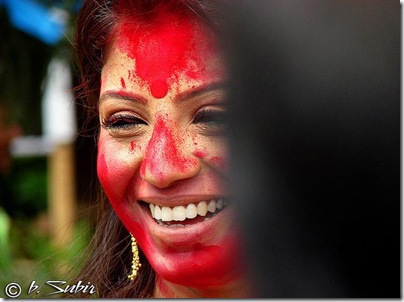
hop again the next day. Check out more girls. Immediately try and look them up on Facebook with your smartphone if you hear a name like Chaitali or Barnali called out loud. And if you are one of the more adventurous ones, you even ask her out for an egg roll being made right outside the canopy of that pandal. egg roll shindur Durga Puja for me is a reminder that happiness finds its way home. Every year. That every woman looks stunning on Dashami after a vermillion bath. That if you touch the feet of elders on Bijoya, you get a plateful of mishti, narkel nadu, tok-jhal dalmut and ghugni.

Durga Puja means we are still breathing…

Here is how you can participate in Beyond Five Days of Durga Puja:

  • Have recipes and dishes that symbolize or represent Durga Puja, which you have cooked or eaten or both
  • A story, a memory and a bagful of nostalgia around Durga Puja. You can become the narrator for someone else in your family!
  • Have a home décor idea/ theme for Durga Puja
  • Have photographs taken by you of Durga Puja, and all that fanfare around it. Don’t forget to add captions and little details about each photograph.

Post your entry on your Blog and link to this event. Also don’t forget to leave a comment here so that viewers are led to your post. Also send me an email at preeoccupied@yahoo.com with the following details:

  1. Title of your post
  2. URL of your post

There are no constraints on words, and archived posts are also welcome as long as a direct link to Beyond Five Days of Durga Puja appears on your post.

If you don’t have a Blog, you can still participate. Send me a mail at preeoccupied@yahoo.com with the following details: mention Beyond Five Days of Durga Puja in the subject line of your email.

  • Title of your story/write up
  • Your write up in MS Word
  • Your name and location (will not be published, if you don’t want to)
  • Preferably watermarked photographs in JPEG format

The last date to receive your entries for Beyond Five Days of Durga Puja is October 10, 2010.

I look forward to celebrating Durga Puja with you.

Till then, in the words of my great grandmother, Dugga Dugga.