Monday, March 14, 2011

Maacher Muro Diye Mugger Daal

We are not a family of werewolves. We are Bengalis. A community which is known to eat fish in all its forms and with all its parts. Including the coveted head.

IMG_1469
Maacher Muro
with Mugger Daal is a big fish head (usually Rohu or Katla) cooked with yellow mung dal. Its a wedding and special occasion tradition.

My father taught me how to work my way into a fish head. The process is meticulous and requires some patience. The eyes and the brain of the fish are the most sought after. They say those are the best parts of the fish head, good for eyesight and the brain. That explains all the Bongs out there with exponentially celestial cerebral equity. Its the fish head, I tell you!

This recipe is my Mother’s of course, and I have re-created it in my kitchen out of greed. That insatiable desire to dunk my hand into a bowl of dal and fish out (pun definitely not intended) a big piece of the head.

IMG_1484 Just as the Muro Diye Mugger Daal is here, brimming with flavors and the taste like that from an outside world, I am reminded of a little story my Father always loves to narrate. How he never got a chance to eat the Maacher Muro in his wedding feast. Reason? He was too shy to break into the big fish head when my Mum’s relatives laid out the feast for the new groom. And some benign lady apparently in some kind of hurry, thought it was wise not to embarrass the notun bor with a fish head and took the big Rohu muro away while my Father looked at it longingly. This happened exactly 36 years ago, but the vividness with which he re-tells this incident is still fresh and funny!

Ingredients for Maacher Muro Diye Mugger Daal are:

For the fish head:

1 big fish head (Rohu or Katla) cut into half, cleaned and washed
1 teaspoon turmeric powder
Quarter cup mustard oil
Salt

IMG_1470 IMG_1472 IMG_1475 Smear the head with the turmeric and salt. Heat the oil until smoking and fry the fish head – about 3-4 minutes on each side. Remove with a slotted spoon and keep.

For the dal:

1 cup yellow mung dal
2 tablespoons ginger paste
4-5 green chilies, slit lengthwise
1 teaspoon heaped red chili powder
1 teaspoon heaped turmeric powder
3-4 bay leaves
2-3 black cardamoms
2-3 green cardamoms
1 stick of cinnamon
5-6 cloves
3-4 tablespoons desi ghee
Sugar
Salt

IMG_1476

In a pressure pan, dry roast the dal till golden brown. Do this on low-medium heat and babysit the dal so that it doesn’t burn. Remove and keep aside.IMG_1479

IMG_1480 In the same pan, heat the ghee and add the bay, cardamoms, cinnamon, cloves and the green chilies. Sauté for a couple of minutes and add the dry-roasted dal.

IMG_1481 Mix the dal well with the whole spices and the ghee. Add the ginger paste, turmeric and red chili powder.

IMG_1482 On medium heat, mix together all the ingredients. Add the fried fish head and mix again. Let this cook for about 3-4 minutes till the fish head starts disintegrating into the dal and spices.

IMG_1483 Use your spatula to give the fish head a helping hand. Add two – three cups of water and simmer. Season with sugar and salt.

Cook the dal till done, but not mushy. I would say about 15-20 minutes, covered all the time. If you see the water drying up too soon, add some more.

IMG_1485 This dal will not be runny and have a thick consistency, more so because of the fish head added to it. The head would have now broken down quite a bit and you will see it mixed well with the dal and spices. Do a taste test and add sugar and salt if needed.

IMG_1490 The Maacher Muro Diye Mugger Daal usually starts a lot of meals. Serve it with rice, crispy alu bhaja, and a wedge of Gondho Lebu and you will have a meal fit for a queen or a king! Follow it up with this or this. A meal like this usually ends with a bowl of chilled Payesh.

Sunday, February 13, 2011

Jamie’s Whole-roasted Chicken with Homemade Barbecue Sauce

The star of this recipe is the barbecue sauce that Jamie quickly puts together. I just copied him using some of my own measurements. Just the sauce is so awesome that it got my taste buds going as it filled my hands and the home with the most fantastic smells.

IMG_1274 IMG_1280 IMG_1282 IMG_1281 The idea of using fresh, gutsy, woody herbs and spices and aromatic ingredients are a great olfactory turn on for me.

Ingredients for Jamie’s Whole-roasted Chicken with Homemade Barbecue Sauce are:

1 whole chicken, skin on, without giblets (about 1.5 kg)

IMG_1285 With a pair of kitchen shears, remove the backbone of the chicken and “open (the bird) down like a book”. Score the chicken on its legs, thighs and breasts.

For the dry spice mix:
2 teaspoons fennel seeds
1 teaspoon cumin seeds
10-12 black peppercorns
4-5 cloves
2 teaspoons salt

In a mortal and pestle, bash all the dry spices till coarse and keep. IMG_1286
For the sauce:
3-4 sprigs of fresh rosemary
4-5 sprigs of fresh thyme
4-5 fresh bay
1 pod of garlic
2-3 red chilies
Half cup Balsamic vinegar (I did not have it at home and used regular vinegar)
2 tablespoons smoked paprika
Juice of one orange
Zest of one orange
Three-fourth cup tomato ketchup (Jamie used organic)
2 tablespoons canola oil

On a chopping board, put together the rosemary, thyme, garlic cloves, red chilies and orange zest. Chop everything in together and into each other!

IMG_1287 IMG_1290
In a baking dish, toss in the chopped fresh herbs, etc., the dry ground spices, fresh bay, tomato ketchup, vinegar, orange juice, and smoked paprika.
IMG_1291IMG_1292 
Mix all the ingredients well. Lay the chicken on the sauce and massage the sauce into the chicken. Make sure you cover all the nooks and corners. Jamie does not marinade the chicken, I however kept my bird in the barbecue sauce for an hour. If you have more time, I suggest marinating for 5-6 hours.

IMG_1293 IMG_1295 IMG_1299

Preheat oven to 375°F. Start with the chicken face down in the baking sheet. Drizzle a little oil on the chicken and toss it in the oven for one hour 30 minutes. Turn the chicken once mid-way of cooking.

IMG_1300 IMG_1304
Its not possible for us to do an outdoor barbecue in this weather. But on a clear, summer day, I am going to do what Jamie did! Barbecue the bird on an outdoor grill with this heavenly sauce.
IMG_1305 IMG_1308 IMG_1314This chicken is one of the most “simple, honest and bloody good” things I have eaten in a long, long time.

P.S. If you have not seen this TED talk by Jamie, please do.

Friday, February 11, 2011

Pôddar Ilish Paturi in the Microwave

Apparently the best and the most precious Ilish (Hilsa) comes from the river Padma of Bangladesh. Pôdda is the Bengali name for the same river.

hilsa_1_200908 When I moved to Canada, I wasn’t quite surprised that I got to eat better Ilish here than in India (Bihar and Delhi). Obviously the best produce of any country is exported to the western countries. Plus the Ilish we get here from the Bangladeshi store in Danforth is straight from Padma rather than the Rupnarayan River in Kolaghat.

The best quality of Ilish is known by its silver skin, which almost scintillates to your touch. Its scales are softer compared to a Rohu or Katla, two other voraciously consumed river fish by the Bengalis.

A fresh Ilish’s taste is the avatar of butter. Silken and oily, Ilish has a distinct taste, probably from the freshwater plankton it feeds on. You don’t have to be an Ilish connoisseur to quickly separate a fresh from a not-so-fresh Ilish. The latter will become chewy and also not have its deep and distinct flavor.

I do not know what exactly the word “Paturi” means. But the connotation is “steamed” or bhapa. Traditionally, Paturi is made by wrapping the fish in fresh banana leaves and steaming it. Though I do get to eat the best quality Ilish in Canada, I am not quite close to finding banana leaves (or a tree!) in layers of snow outside. Thus I am forced to settle with something that every city-dweller has convenient access to. The microwave.

IMG_1257 Oh, a rather important thing about Ilish, please do not “thoroughly” wash Ilish. You will just wash off all its flavor and taste. Ideally the scales of the fish are first removed, then the whole fish is washed and cut. But if you get your fish monger to cut the fish for you, bring it home and only lightly wash the pieces.

Ingredients for Ilish Maacher Paturi are:

4-6 slices of Ilish
Half teaspoon + 1 teaspoon turmeric powder
4-5 heaped tablespoons yellow mustard seeds
1 tablespoon khus khus/posto/poppy seeds
2.5 tablespoons plain yogurt
5 + 7-8 green chilies
5-6 tablespoons mustard oil
Salt

Grind to a smooth paste the mustard seeds, poppy seeds, half teaspoon turmeric powder and 4-5 green chilies. Use little water to wet grind. What I do is, first dry grind the mustard and poppy seeds and then introduce the green chilies with very little water to get the smooth consistency.

IMG_1258 Arrange the slices of fish in a shallow microwaveable glass dish.

IMG_1261 Slobber the spice mixture on the fish. Add the yogurt, slice lengthwise the remaining green chilies and add them too. Top the fish pieces up with a teaspoon of turmeric powder, salt and drizzle the mustard oil. With a small spatula, evenly coat everything onto the fish pieces.

IMG_1263 I start with a spatula but usually end up using my hand to get the spices on both sides of the fish.

Cover with a cling wrap and keep for at least 10 minutes. Microwave the fish for 10 minutes.

IMG_1269 Serve the Ilish Maacher Paturi with steaming plain white rice.

IMG_1265

Monday, February 07, 2011

Gota Sheddho Revisited

I am a fourth generation Bengali to grow up in Bihar. I also went to a convent school. Such socio-cultural dynamics are not strange or unheard of in India. But they clearly contribute largely in raising a sufficiently confused young girl.

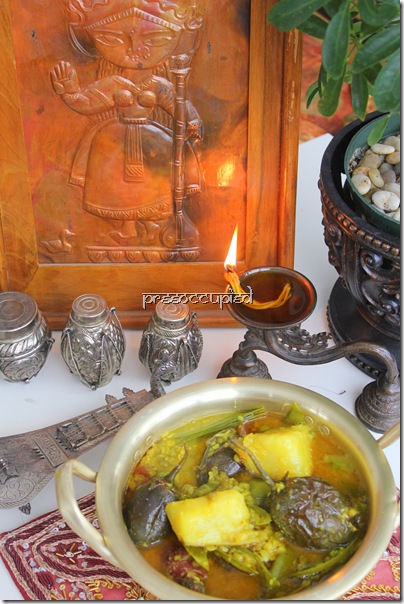
IMG_1194IMG_1220 Tomorrow is Saraswati Puja in India. Growing up, it meant an extra holiday in school. I do not remember myself doing any prayer ritual on this day; although something that lingers on from this day is the taste of Gotta Sheddho, literally translated from Bengali as “whole boiled”.
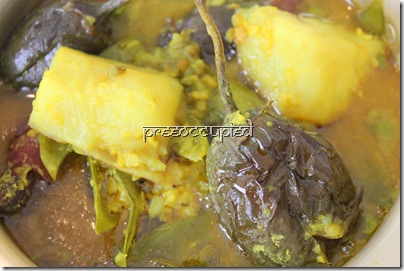
IMG_1231I am told, Gota Sheddho is a Ghoti thing, where Grandmothers and Mothers cook at least five types of whole vegetables with lentils on the day of Saraswati Puja, and eat it the next day, when its cooled down. The day of Sheetal Shasti.

IMG_1199 Saraswati Puja in the part of Bihar I lived in, meant young boys and men setting up pandals in the neighborhood and praying to the Goddess of Knowledge. It often translated into muted nuisance where the more boisterous boys would visit every home in the neighborhood to collect donations or chanda, which sadly was more forced than voluntary. These were also the boys who probably never went to school. So their association with “learning and knowledge” remained questionable.

IMG_1196 But I do not want to undermine the credibility of their efforts in making arrangements for just one day only (though “celebrations” often stretched to a week). Loud music - most often the raunchiest songs of that year made a perfect set up to tease and torment scared girls who ventured out on the streets that day. Another reason for me to stay in and prepare for the final exams coming up the next month. Though traditionally, its a pen and paper down day in India for all students.

But watching young girls and boys in their finest dresses made a great celebration from home. Some girls as young as 12 or 13 would wear saris.

IMG_1212On this day, it is traditional to wear the color yellow (or mustard yellow) to welcome the Spring/Basant season in India. My memories of girls wearing yellow cotton saris, their hairs washed and smelling of Head & Shoulders, making a wet patch of damp at the back of their blouses where their hair ended are quite vivid. Each girl giggling, walking nervously in their little heels when they saw a group of boys coming their way. This day also made for a great desi, pre-Valentine’s Day celebration. All in the name of knowledge!

IMG_1189 With all the Saraswati Puja gung-ho around me, I would shift between bending over the cast iron railings of our terrace to people watch, run to the kitchen to see how Mum was making Gota Sheddho and sprint back to a very visible spot where people could see me “studying”. Clearly I was the only one who was not letting the Goddess of Knowledge down.

Now back to the taste of tradition – Gota Sheddho. There is no one recipe for this vegetarian stew, packed with hearty vegetables. Each family pretty much does it their own way. I will of course share how its made in my family. I had previously made Gota Sheddho on a regular day and the recipe is here.

Ingredients for Gota Sheddho are:

IMG_1200 IMG_1203 IMG_1207 Half cup whole urad dal
Half cup whole green moong
2 small sweet potatoes (either whole or cut into quarters)
Handful of whole green peas, remove the stringy part
Handful of broad beans/sheem, remove the stringy part
6-7 small eggplants
Few green chilies, slit
1 1/2 tablespoon ginger paste
1 teaspoon turmeric powder
2 tablespoon mustard oil
Sugar
Salt

Wash the two dals and begin to boil them in a pressure cooker or a thick bottom saucepan – for about 25-30 minutes.
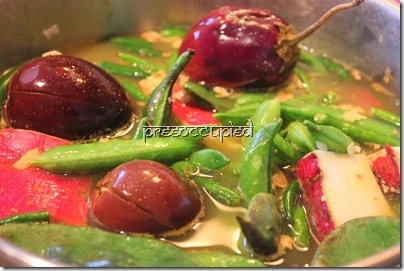
IMG_1209 When the lentils get to a rolling boil, add vegetables, ginger, green chilies, turmeric powder, salt and sugar and pressure cook on medium-high heat for 10-15 minutes or until vegetables and dals are cooked. Just when you think all the vegetables and dals and well cooked but not too mushy, drizzle the mustard oil, remove from heat.

The Gota Sheddho is the right balance of sweet and savory, so do a test taste and adjust accordingly.
IMG_1215IMG_1221