Showing posts with label festival. Show all posts

Wednesday, October 27, 2010

Supermarket Find

I was pleasantly surprised and almost beaming from ear to ear when I found these in a leading Canadian supermarket here in TO.

IMG_2329 I am talking about the clay diyas. The symbol of Diwali. The epitome of grace.

I brought back a couple of boxes of them CAD 2.99 each. IMG_2330 We Bengalis light 14 clay lamps (chhoddo pradip) the evening before Diwali to offer our gratitude to our forefathers. Its a tradition my Mum has been following, and now I am starting to do so. Though its very difficult to remember or know the names of our ancestors.

On Diwali, we Indians go full throttle with all kinds of decorative candles and diya. Call it coincidence or planned connivance, but I even made a couple of hand pinched diyas last week in my Pottery Class!

IMG_2331 Enjoy your Diwali shopping and buy lots of Diyas, they are forever to stay in your hearts and cameras.

Friday, October 22, 2010

Narkel Naru for Lokkhi Puja

Aaj Lokkhi Pujo, which means Narkel Naru is necessary. IMG_2265

So it was natural for me to give in to peer pressure. IMG_2269 IMG_2270IMG_2277 IMG_2260

Ingredients for Narkel Naru/Bengali Coconut Laddu are:

3 cups shredded coconut (fresh or packaged; I used the unsweetened kind)
300 ml sweetened condense milk
1 cup plain milk
6-8 green cardamoms, coarsely ground

IMG_2248
Move around the coconut in a thick bottom pan for about 4-5 minutes on very low heat. Add the condense milk and the cup of milk, mix well. Keep the heat at the lowest gas mark.

The coconut and the milk mixture should start bubbling on the sides and get thicker. Keep mixing it with a silicon coated ladle if you have, else use a steel spoon. Make sure you keep scraping the bottom of the pan and watch the mixture all the time.

After about 10 minutes on low heat the mixture would have cooked. Turn the heat off and add the cardamom powder. Give it a good mix and let the coconut mixture cool down.

When the mixture is cool enough for you to handle, make little lemon-size balls with your hands and place on a clean platter. This quantity makes about 20 naru/ laddu.

Store in an airtight box and do refrigerate.

IMG_2274 IMG_2253 The Narkel Naru is an essential offering in many Indian festivals, and particularly the Lokkhi Puja/ Lakshmi Puja that Bengalis do just after Durga Puja.

IMG_2249 IMG_2272IMG_2253 IMG_2257May the Goddess of Prosperity and Wealth shower her blessings on all of you and some Narkel Naru too, but watch that head. Bhalo theko.

More photos are here.

Thursday, October 07, 2010

Beyond Five Days of Durga Puja: Mahalaya Agamoni, Invoking the Mother Goddess

(Photographs by amateur photographer, guitarist and animation filmmaker Shubham Paul.)

33898_1623762398550_1371196376_1588549_7782489_n62936_1633919252465_1371196376_1609204_5429369_n
(This post is part of the event at PreeOccupied, Beyond Five Days of Durga Puja.)

Sunday, October 03, 2010

The Making of Gujia, Handcrafted to Imperfection

I essentially followed Soma’s Gujia recipe and some of her measurements for this one. I also added khoya which Soma had chosen not to add in her recipe. Meanwhile, I grabbed hold of one of my childhood friends from New Jersey on an instant messenger window and sought more handholding on “moulding” these sweet empanada-like Indian fried pastries. I knew from her Facebook update she had made Gujias for Teej a few weeks ago.

IMG_1910 I had made the khoya last night, which made life easy. It was a Sunday, which meant P was around to break a coconut for me. A quick call to my Mum in India on how to handle khoya, and I had more confidence bubbling inside of me. I believed I was set to make Gujias for the first time. After all, I had three very experienced people backing me up. And the fourth, a curious but a rather inexperienced one when it came to Indian sweets was peeping down my shoulders. I could never let all these people down. Now could I?

Ingredients for Gujias are:

For the pastry dough:
One and half cup all purpose flour
3-4 heaped tablespoons of ghee
1-2 teaspoons of powdered sugar
Pinch of baking soda

For the filling:
1 cup khoya
1 cup grated fresh coconut
4 tablespoons powdered sugar
Handful of chopped cashew
Handful of skinless, slivered almonds
Few raisins
Half teaspoon cardamom powder
Pinch of dry ginger powder (Soma particularly insists on this)
1 tablespoon ghee

For deep frying:
Ghee

In a bowl, mix flour, baking soda and ghee with your hands. When they become crumbly, add water and knead a smooth dough. Keep covered with a damp piece of cloth.

IMG_1897 Heat one tablespoon ghee in a pan, add the nuts and almonds, sauté for a few seconds and add the khoya.
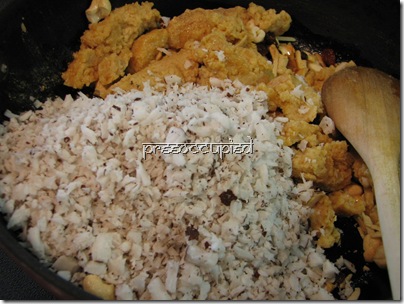
IMG_1898 IMG_1899 Mix everything well before adding the grated coconut. Cook for a couple of minutes, add the cardamom and dry ginger. At last add the powdered sugar, give it a quick stir and turn off heat. Let the mixture cool down before you use it to fill in the pastries.

Heat ghee in a wok for deep frying the Gujias.

Roll little puris / little discs with the portions of the dough. Place a tablespoon of the filling at the center of the disc, fold making it a half-moon. Use water on your fingertips to seal the pastry. Pinch an ear of the pastry right at the top and crimp your way to the bottom, or use the tines of a fork make little patterns on the edges.

IMG_1900 IMG_1901 Gently release the Gujias into the hot ghee and fry on both sides till they look scrumptiously golden brown. Place them on baking racks to cool completely.

IMG_1909 My Gujias looked they were hand-crated by a first timer. But I am sure you will do a much better job.
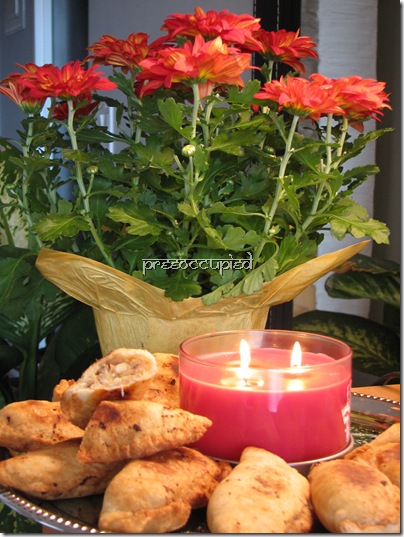
IMG_1907 These quantities made about 14 Gujias. Oh wait, there were 16 actually, adding up the two P and I ate, piping hot, straight out of the fryer.

Keep the Gujias in an airtight box, till you have just one left, and four people to share it with.

IMG_1911

Friday, September 10, 2010

Ganesha Grove

IMG_0832IMG_0834 IMG_0836

Ganesh (sometimes spelled Ganesha, but usually pronounced "ga-nesh") is also known as Ganapati. He is the son of Parvati and Shiva. Lord Ganesha brings knowledge. But he is most often known as the "Breaker of Obstacles".


IMG_0839IMG_0843 IMG_0842

Ganesha is represented as a short, pot-bellied man with yellow skin, four arms and an elephant's head with only one tusk. In his four hands he customarily holds a shell, a chakra(discus), a mace and a water-lily. His unusual steed is a rat.
IMG_0850 There are many versions of how he was conceived. The most popular version is that Shiva and Parvati were leading a quiet life on Mount Kailash, Shiva's abode. In fact, life was too quiet and sedate for Parvati, who had nothing much to do all day as her chosen lord was mostly either immersed in deep meditation or obfuscated by the fumes of ganja (marijuana). For company there was Nandi, Shiva's bull, and his host of ghosts, who are said to inhabit Kailash and give Shiva company, especially when he smokes ganja and wants some song and dance to liven things up a bit. Of course, Parvati was feeling bored and wanted someone she could be more involved with. IMG_0860 So she began to call upon Vishnu in prayer to grant her a son. Vishnu soon granted her wish and Parvati gave birth to a beautiful boy child she named Ganesha. Read more here.

IMG_0835 IMG_0858 IMG_0859 IMG_0844 Wishing you all a very happy and prosperous Ganesh Chaturthi, hope the elephant-headed God brings to your home wisdom, knowledge and righteousness.