Showing posts with label mustard paste. Show all posts

Wednesday, July 25, 2012

The Golda Chingri Rises With Narkel-Shorshe

I must tell you that this was made on the spur today. I pretty much decided at the nth moment that this is what I wanted for dinner tonight. For my hasty decision, the pictures for this post have suffered and I have really *beep* photos today.

IMG_3257

I have made this same recipe with headless shrimps, and I do notice the difference good old Golda can do to a recipe. So if you can, please use large prawns with heads for this recipe.

IMG_3243

Ingredients for Narkel-Shorshe Chingri are:

12 large prawns/Golda Chingri with head, deveined and head cleaned
Half cup grated fresh coconut (just the white portion)
4 tablespoons yellow mustard seeds (shorshe)
1 tablespoon brown mustard seeds (rai)
10 green chillies, slit lengthwise
1 teaspoon turmeric powder
5-6 tablespoons extra virgin mustard oil
Banana leaves (not necessary but important)
Salt

IMG_3246Line the banana leaves in a microwaveable bowl. Lay the prawns/chingri on them in a way that all fit in the bowl. Sprinkle half a teaspoon turmeric powder on the prawns and keep.

IMG_3249
IMG_3250

In a blender, dry grind the two kinds of mustard seeds until coarse. Add the remaining half teaspoon turmeric, throw in a couple of green chillies and add the grated fresh coconut little by little. Grind this mixture to a coarse paste. Add little water while grinding.

Now slather the mustard-coconut mixture on the prawns till all of them are coated well. Top the ingredients with the slit green chillies, drizzle the mustard oil, and season with salt.

IMG_3252

Now add another sheet of banana leaf on top of the prawns. Tightly wrap a cling film/wrap on the bowl to cover the banana leaves. Leave for 30 minutes.

Then microwave the whole thing for 12 minutes. Make sure you time it well and do it just before you eat your meal.

IMG_3256Remove the cling wrap and the top layer of banana leaf just before serving.

Serve the Narkel-Shorshe Chingri with plain white rice.

Monday, May 14, 2012

Ilish Maacher Paturi Photoshoot and Some Learnings

So I took this Bobby Flay-like challenge upon me to make Ilish Maacher Paturi the way it should be, wrapped in banana leaves! No steel tiffin box or microwaveable bowl came in my way this time. I had suffered enough scorn from Bengali food-e-ratis for long. It was now time for redemption.

049

I used one heaped tablespoon of yellow mustard seeds, one teaspoon of black mustard seeds and one teaspoon of poppy seeds along with few green chillies, and a teaspoon of turmeric to make the marinade for the paturi. Once all the ingredients were wet ground to a smooth paste, I slathered it over the fish steaks. The Ilish we get here is from a Bangladeshi store, they have the best Padma river Ilish, known for its distinct taste and buttery texture.

020The thing about Ilish is that you don’t need to wash it thoroughly. Too much washing will drain the taste out of this king of fish! Ideally, a whole fish should be un-scaled, washed and then sliced.

022To the mustard marinated fish I threw in few more slit green chillies and some salt and drizzled mustard oil. Mustard oil is one of the most essential ingredients in an Ilish Maacher Paturi, please do not substitute it with any other oil. It will be Ilish Paturi blasphemy.

032
I kept the marinated fish covered for about 15-20 minutes, before I transferred each individual Ilish piece (with its marinade and the mustard oil; drizzle some more if you want to) on a rectangular piece of banana leaf.

034
038
I found the banana leaves in the frozen section of a Chinese grocery store. Make sure you wash the frozen leaves with warm water before you wrap them around the fish. This way they will soften a bit and will not tear.

039
040
I used kitchen twine to make banana leaf packets for my fish. You can use bamboo cocktail picks to keep the ends of the leaves together.

044Each packet was then kept in a large baking dish and microwaved for 10 minutes. I did think of my traditional bamboo steamer for cooking the fish, but then got lazy and settled to microwave. I don’t think the end result suffered because of that.

Time the cooking process of the paturi well, so that you can serve the dish just before you are sitting down to eat your lunch or dinner.

051Snip off the twines and unwrap each leaf to keep on the plate in which your guest/you will eat.

045
Ilish Maacher Paturi
needs nothing else but pearly white plain rice to eat with and your deft fingers to artfully make morsels of the fish and rice and its zingy mustard sauce to transfer you into Ilish heaven. Return from there would be very difficult, because everything then will look so ordinary.

052

Wednesday, May 09, 2012

The Good, the Bad and the Bengali English; Now Translate Potol

A couple of days ago, when we were singing paeans about Tagore, updating our status messages on Facebook about the literary achievements of the genius called Rabindranath, somewhere in a dark corner of another world, some Bengali was heard saying (to his host) - the phood was yammy! (Literally translated as – I do not know the difference between the sounds “u:” and “ɑ:”. Why? Because my mammy did not make me laarrn.)

There is something endearing about us Bongs and our pronunciation of English words. I admit, we are no Jhumpa Lahiris out there to impress the English-speaking world, hence we have all the right to roll our eyes and say - Bhee the peepull, with as much pride as our Big Sista in Calcutta does.

It does not take long for a non-Bengali to discover that we Bongs mix up our “w” and “v”. In vain is most certainly In wain, and a woman is always a voman. Try saying that ALOUD. But to do that, you will need the soul and the soft, mellifluous voice of a Bengali. That would mean you will have to take a huge riks (read risk; pronounce riks!). While we are on the topic of enunciation, its not entirely unusual for the phish-eating Bengali to mix the “f” and “ph” sounds. The accent gets thicker when he is drinking.

I have never known a Bengali who writes grammatically incorrect English. In my circle of Grammar Nazi friends, we poke fun at each other for our community’s inability to pronounce certain words. That’s how perfect we are. At least in our heads. And I am not even venturing on to talking about the bushy-faced Bengali still hanging on to his embroidered jean pant and bush shaart.

Perhaps another day.

But my favourite mention will be from the recent movie Bhooter Bhobishyot, where the front desk lady at the real estate developer’s office is heard saying (to someone) on the phone, Hard diks crash hoye gæche. Kichchu shave hochche na.

I squealed with glee. Little things make me happy.

008That is exactly the reason I turned these mundane-looking potols into a dish fit for royalty. The Shorshe-Narkel-Potol. That’s Parwal in Mustard and Coconut for you.

059


Ingredients for Shorshe-Narkel-Potol are:

10-12 potol/parwal washed
1 heaped tablespoon yellow mustard seeds
1 teaspoon black mustard seeds
1 tablespoon poppy seeds/khus-khus/posto
Half cup grated coconut (I use the freshly frozen kind)
5-6 green chillies
2-3 bay leaves
4-5 tablespoons mustard oil
Sugar
Salt

Begin by randomly (but gently) running a blunt knife on the potol. Just to scrape off lengthwise bit off the skin from places. DO NOT peel the skin off. Cut both sides of the ends. You can keep the potol whole for the recipe or cut them in halves if they are larger.

020

018

Grind together the mustard seeds, poppy and green chillies. Start by dry grinding the seeds first, once a coarse powder, add the green chillies and a little water to do a coarse wet paste.

010
013
014

For the coconut, do a coarse wet grind and keep.

022

Heat mustard oil in a thick pan and add the bay and potols. Sauté on high for 4-5 minutes. You can cover and cook till the potols get lightly coloured at the edges.
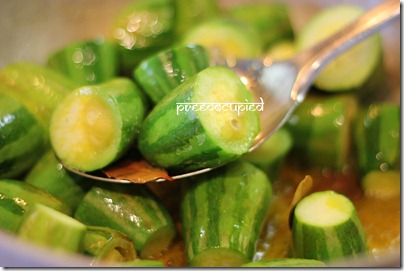
028
029

Add the mustard-poppy-green chilli paste to the potol and mix well till the vegetables get coated with the paste. Reduce the heat and cover again.
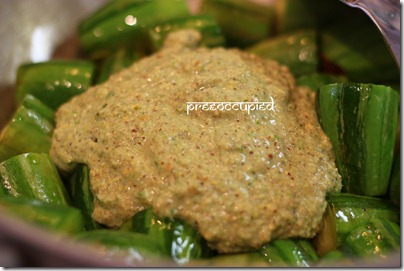
030
After about 4-5 minutes, add the coconut paste. Give it a good mix, cover and cook for about five more minutes.

032
033

The moisture from the wet ground ingredients will help soften the potols. Make sure you keep scraping the spices from the bottom of the pan, else they may burn.

Once the potol has cooked, add the sugar and salt. Cook uncovered till the extra moisture evaporates and the spices and the coconut cling on to the potol.

034
056Do one last taste test and season with more salt and sugar if necessary. You can throw in a couple of broken green chillies to add some more heat or leave the dish as it is. I did not add any turmeric to my dish. Just because I wanted the natural colors of all the ingredients to show. You can, if you want to.

An accent-deaf Bengali would eat this Shorshe-Narkel-Potol with mushurir dal and rice. And maybe a rui maach bhaja on the side.

Tuesday, October 19, 2010

Amala Sen’s Bitter Gourd Side with Mustard, Garlic and Tamarind

Every cook needs aunts and great aunts to pass down their recipes. And cooks who Blog have an extended family who are also happy to pass down their family recipes.

Amala Sen is Sumana Mashi’s Kakima (Aunt) whose signature bitter gourd side was the star of many meals.

IMG_2174 Its a simple bitter gourd-potato sauté but with some unusual ingredients for karela. Since Sumana Mashi took the pain to type out the recipe, and make my work simple, I will just go ahead and do something that I don’t usually do on PreeOccupied – use the Ctrl C-Ctrl V keys.

Amala Sen's (my aunt) Karela recipe: Since she never really provided any measures, here I go.

  • Two large or four medium karela, cut in crescents, washed and rubbed with salt and turmeric
  • You'll need also enough similarly sliced potatoes to make about 2/3 of the karela amountIMG_2180
  • In karahi/pan heat 3tbsps oil (I use olive, she did mustard) and pop 1 tsp or so 'panch phoron seeds' i.e. mustard, methi, kalonji, fennel. Jeera (in some kitchens, randhuni/celery seeds). IMG_2182
  • Add karela slices and fry for 5 minutes so all pieces seem lightly browned. Now add the potatoes, stir fry for another 5 minutes. IMG_2183
  • Sprinkle salt for the whole amount and a 1/2 tsp or so more of turmeric. IMG_2184
  • Cover and cook on medium heat as usual. Meanwhile in a small blender jar or coffee grinder crush fine 2 tbsp mustard seed. (if it's wet ground always add a pinch of salt and a small piece of green chili to stop the acridness) I always check dry ground stuff by taking and pinch of it and adding a few drop of water--is it smooth or rough at this stage?
  • Back to 'karela'--also crush in pestle 4 cloves of garlic and have some freshly ground black pepper handy.
    Check to see if karela is cooking in its own moisture--best not to add water which dilutes taste. If its too dry add a sprinkle of water. IMG_2188 IMG_2189
  • When karela and potatoes are cooked, make a well in the centre of karahi pushing veggies up the side, turn up the heat a few notches and when the well-bottom has no moisture add 2-3 tbsps of mustard oil.
  • Bring oil to smoking point, add the crushed garlic cloves and brown slightly before mixing it all.
  • Now add the mustard paste, ground black pepper and stir around.
  • For the final touch you need about 2tbsps of thick tamarind paste thinned out with a bit of warm water. IMG_2191
  • Mix this all in gently, taking care not to break karela pieces. The result should be on the dry side--a happy combo of bitter, tangy, garlicky, tartish tastes spiked by the pepper and mustard oil. You can eat this with rice or chapatis.IMG_2199 IMG_2201 All I did was follow Sumana Mashi’s instructions and out came a tangy, garlicky, delectably good Bitter Gourd side, which we had with Rice and Sambar.

Thank you, Sumana Mashi.

Other bitter gourd recipes from PreeOccupied are here.

Tuesday, August 24, 2010

Sōjnē Dãtā Chorchori

Sōjnē Dãtā is Bengali for Saijhan, Sajna or Drumsticks (Moringa oleifera). Its essentially a summer “vegetable”, where the local bazaar would get these fresh-looking, juicy pods packed with vitamins, calcium, and other important nutrients.

IMG_0356 But nutrients are not exactly the reason I got these juicy Sōjnē Dãtā and made a Chorchori out of them, even though I did not have all the ingredients at home. Traditional Chorchori will have a medley of vegetables and greens, sometimes even fish head.

IMG_0443 My constant cravings had me dreaming about Dãtā almost twice in one week. And a trip to the Bangladeshi store in Danforth helped me get my fill.

 IMG_0460 Ingredients for Sōjnē Dãtā Chorchori are:

4 drumsticks, cut into two inch pieces
1 potato, peeled and cut into wedges
2 tablespoons mustard paste
1 tablespoon poppy seed paste
Half teaspoon paanch phoron
Half teaspoon turmeric powder
Half teaspoon red chili powder
1 bay leaf
Mustard oil
Sugar
Salt

Heat oil in a wok, toss the drumstick pieces in and sauté for a couple of minutes. Remove with a slotted spoon.

IMG_0446

In the same oil, add the potatoes and get some color on them. Remove after 3-4 minutes. You can also add thinly cut eggplant and pumpkin to this dish. I did not have either!
IMG_0448
Toss in the paanch phoron and bay leaf and sauté for a minute. Add the already sautéed vegetables, spices and the salt and sugar. Give everything a good mix, cover and cook for 3-4 minutes on medium heat.

IMG_0449 IMG_0450 Add enough water to cover the vegetables and cover. Cook for enough time that the potatoes and drumsticks are done.

Check the seasoning and balance the sweet and salt. If too much water remains in the dish, just crank up the heat and cook for a few more minutes. 
IMG_0459 Enjoy the juicy taste of this Drumstick chorchori with some plain rice. A dish like this is usually preceded by some daal and bhaja and then followed by a fish or mutton curry.

IMG_0455