Showing posts with label Chilies. Show all posts

Monday, November 22, 2010

Sanjeev Kapoor’s Banarasi Chilli Chicken

There is nothing much to write about this recipe since it is not mine or my Mum’s. You go watch the video where Chef Sanjeev Kapoor demonstrates how he made his Banarasi Chilli Chicken.

IMG_3015 Of course, when you come back, I will give you my measurements and pictures for his recipe.

Ingredients for Sanjeev Kapoor’s Banarasi Chilli Chicken are:

500 grams boneless chicken (I used thigh pieces, which are more tender than breast portions)
Quarter cup + quarter cup dark soy sauce
2 tablespoons + 2 tablespoons green chili sauce
2 tablespoons + 2 tablespoons cornstarch
1 medium size red onion, halved and cut into thick slices
1 medium size green bell pepper/capsicum, halved and cut into slices
6-7 fat cloves of garlic, peeled and finely chopped
5-6 green hot peppers/chilies, chopped finely
Half teaspoon black pepper powder
Canola oil for deep frying
1 egg
Salt

IMG_2999 
Cut bite-size pieces of the chicken. In a bowl, mix together two tablespoons cornstarch, the chicken pieces, quarter cup soy sauce, two tablespoons green chili sauce and the egg. Both the sauce already have salt in them, hence I did not add it while marinating the chicken (unlike the Chef). Eating less salt won’t kill me, eating more might.

Sanjveev Kapoor suggests you marinate the chicken for at least 30 minutes, I left it for about an hour and a half.

Heat Canola oil in a wok until smoking. Release the marinating chicken pieces into the hot oil. Fry till they turn golden brown in color. Remove. Do it in two-three batches if your wok is small. IMG_2998IMG_3000

From the same oil which you used for deep frying, take a couple of spoons of oil and heat in the (same) wok. Add the chopped garlic first and sauté for a couple of minutes on high flame without browning the garlic.

IMG_3001 Next, throw in the onions and toss them around to coat the garlic and the oil.

IMG_3003 While the onions are still pink, add the sliced capsicum.

IMG_3004 After a couple of minutes of cooking the capsicum with the onions and garlic, add the soy sauce and green chili sauce as the Chef suggests. Whisk the remaining cornstarch with half a cup of water and keep it ready. As the sauces start bubbling at the sides, add the cornstarch mixture little by little. Keep mixing continuously on high heat.

IMG_3005 Now add the already fried chicken pieces into the saucy mixture. Coat well. Lastly, throw in the chopped green chilies and the black pepper powder.

IMG_3008IMG_3009 Give it a taste test and if you think you want to add any salt, adjust it now. There should not be any extra sauce in the Banarasi Chilli Chicken when you finish cooking.

IMG_3014Turn the heat off and serve with paratha, roti, chowmein or fried rice. Or just have it on its own with a glass of chilled beer!

IMG_3012What’s your favorite thing to eat with the much-loved Chili Chicken?

My other Chili Chicken recipes are here and here.

Tuesday, May 18, 2010

Murgi’r Jhol - Chicken Curry With A Soul

How many times have you killed your chicken and cooked it too? I guess not too many times.
IMG_8221But Prabha did it every time she and her little brother wanted to eat some.

Prabha (pronounced Prðbha) was about 10 years older than me. She lived with my Kaka and Kakima (Uncle and Aunt) to look after my cousins. When my cousins were away for school, she would also do some cooking. Those simple earthy Bengali recipes which many of us would think its most convenient to buy from Bengali stores or restaurants.

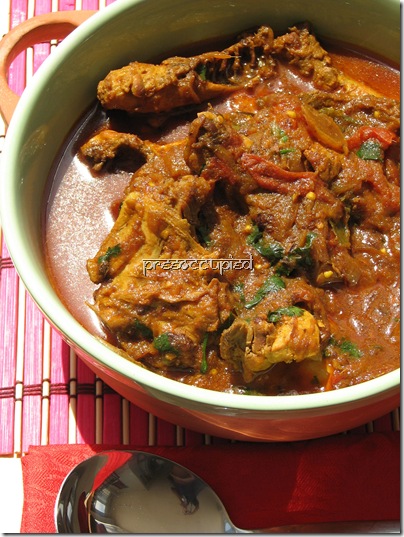
There are as many different chicken curries as there are cooks. Although this post seems to be about a Chicken Curry, but really its not. Its about Prabha and her Murgi’r Jhol.
IMG_8231

There was nothing strikingly different about Prabha except the long printed frocks she wore, and her long hair which was always glistening with oil and braided neatly and folded midway, to reach the center at the back of her head. A single cotton black ribbon, the width of her palm held it up there in a bow. Very, very tightly. 

Prabha also loved oiling my hair, which I later found out was an instruction from my Grandmother. Most afternoons during my vacation there, she would sit with a bottle of coconut oil on a small wooden stool and me by her feet while she’d take scoops of hair oil and nourish my scalp. The dripping oil would soon vanish into the pouffe of my hair. She would then take a comb to make two plaits with my hair.

It was during these one-on-one sessions in the afternoon that the not-so-talkative Prabha opened up to me with her stories about her little village in Bengal. How she thought my Kakima rescued her from poverty and a life of misery and gave her a home and a better life.

In the next couple of years, my interest in cooking was just beginning to surface. Most afternoons, I would sit on my haunches next to Prabha in my Aunt’s kitchen, and watch her make Sondesh, Nadoo, Goja, or the sweet of the day, while everyone else was enjoying their siesta.

It was during one such culinary session with Prabha that I saw her make this Chicken Curry. It wasn't some great gourmet, but this was how she learnt it from her Mother, I was told. I had my notepad ready.

As she was washing the pieces of the chicken under the courtyard tap, she said, “I used to catch my own chicken from someone else’s farm and kill it. My Mother would then clean it and cook it for my brother and me.”

I was already fascinated though I did not delve deep into the brutal method she chose to kill for her meal.

By the time, I had finished writing the ingredients, Prabha was already crushing a knob of ginger on the kitchen counter and throwing it in with the sliced onions which were sizzling in the mustard oil.

IMG_8222The city girl that I was could not keep pace with her, and fumbled writing down each step while she mesmerized me with her speed slicing.

“How much coriander powder?” I asked Prabha. She mumbled something and showed me the quantity by pursing  her five fingers in a round shape! I realized then that Prabha was beyond any measurements – culinary or otherwise!

Since that last Murgi’r Jhol session with Prabha, I have lost that notebook and all contacts with the girl from a small village in Bengal. But her great-tasting Murgi’r Jhol and fond memories are still with me.

This is the Murgi’r Jhol I associate with Prabha. I hope I am able to come close to the thought, effort and time she invested in making the chicken curry for us.

Ingredients for Murgi’r Jhol are:

One Cornish game hen (you can use regular pieces of chicken)
1 red onion finely sliced
5-6 green chilies slit lengthwise
1 ripe, medium tomato, cut into thick slices
Handful of coriander leaves finely chopped
2 tablespoons ginger-garlic paste
1 teaspoon red chili powder
1 teaspoon turmeric powder
1 teaspoon coriander powder
Pinch of garam masala powder
1 bay leaf
1 black cardamom
2-3 tablespoons mustard oil
Pinch of sugar
Salt

Heat mustard oil till almost smoking. Add the pinch of sugar and let it caramelize. Now add the bay leaf and black cardamom. Immediately add the sliced onions and fry on high-medium heat till the onions get a brown color. Add the chicken pieces and fry for 7-8 minutes stirring continuously. Add the slit green chilies. IMG_8225When the chicken is nice and brown, add the ginger-garlic paste and cook for five more minutes, covered with a lid. IMG_8226 Add the dry spices – turmeric, red chili and coriander powder.

The pieces of tomato and salt go in next. Cover and cook for sometime on medium heat. IMG_8228Add about two cups of water and cover. Cook for 10 minutes till all the raw taste in the spices is gone.
IMG_8229Sprinkle a pinch of garam masala powder and chopped coriander.
IMG_8232Serve this Murgi’r Jhol* with steaming rice that has a smear of desi ghee.
IMG_8233 IMG_8235*A jhol essentially is a thin gravy and its okay to have this chicken curry a little runny!

Monday, April 26, 2010

My Corny Story

The first time P and I had bhutta (or fire roasted corn on the cob) together was about a week into being married.
bengali wedding dollIt was the monsoon season in India then. We were a newly married couple who in this time and age had chosen the path of “arranged marriage”. We were still adjusting to the idea of living with each other, often totally puzzled by each other’s presence.

That evening, we had had a difference of opinion. A slight tiff which made me all teary-eyed. And the lump in my throat grew bigger when I saw P walk out of the main door to deal with the crisis his own way! But I held back on my tears.

Half an hour later I called on his phone, only to hear it ringing in the bedroom. I was hoping it wasn't a deliberate move by my new husband.

I kept sitting on one of the rattan chairs in the balcony. The balmy air of a Delhi evening in the month of August mixed with the smell of fresh rain somewhere filled the twilight air. Sometimes whiffs of the Rajnigandha flowers from one of the vases inside would caress my senses, reminding me of the wedding day floral garland I was decked up in. This I tell you was the tear jerker! I slammed the door to shut out all memories of my wedding.

I did not hear my new husband return. It was only when I felt my hands pressed against the warmth of a corn on the cob that I smelt his signature cologne mixed with the earthy smell of bhutta. Heaven.

He knew I liked a little squeeze of lemon mixed with salt and one green chili with my bhutta. It was all there. The evening just got complete with the most adorable and heartwarming smile P could ever give me. bhuttaThrough my muffled sobs and opening my mouth to bite into the nicely roasted bhutta all at the same time, I heard him say, “Naa-o, bhutta khujte giye deri hoye gaelo.” (I got late looking for the (perfect) corn on the cob.)

Nothing has changed since then. I still am addicted to corn. He still forgets his mobile phone at home. We still fight. I still use tears as a very potent weapon. He still has the most adorable smile.

And the ingredients of our bhutta-eating experience have remained the same too. Lebu-Lonka-Noon-aar-Bhutta! (Lime-Green Chilies-Salt-and-Corn on the cob.)

Its the beginning of the corn season here. Today was my turn to return his bhutta favor, and my broiler seemed to be agreeing to my plan just right! Except that there were no embers flying from the pieces of charcoal the bhutta wala fans. Or smoke getting into our eyes. But looked like some sparks were still left…
IMG_7566 IMG_7570IMG_7569 IMG_7567 What’s your corny story…errrr recipe?

I am sending my “corny story” to Of Chalks and Chopsticks, a monthly food fiction event hosted by Aqua, BongMom, and Sra.

Saturday, April 24, 2010

Labeo Rohita In Mustard Sauce, And Stir-Fried Greens On The Side

Of all the things I anticipated eating by being a Bengali is fish. How unpredictable!

If I recollect correctly, it was in grade eight that I learnt the biological name of rui maach is Labeo Rohita. I had a bad hand at science drawings then, so my grandmother or my little sister used to make all those diagrams for me - Rana Tigrina (frog), Rattus (rat), Ornithorhynchus Anatinus (platypus), or Periplaneta Americana (cockroach).

The only thing I have come gastronomically close to in the above mentioned living beings are frog legs, which upon picking up a packet at a Chinatown store, I quickly backtracked and went straight to the fruits and vegetables section. All my affinity for French and Cantonese cooking did not make me eat frogs for dinner.

But Rui (Rohu) or Labeo Rohita has remained with me since my childhood, in all its forms – jhaal, jhol, bhaja, chop, muri ghonto, just to name a few preparations.

I will concentrate on the jhaal today, which essentially has a mustard base and when literally translated means “hot”. Probably because of the two ingredients, mustard and green chilies which add an unmistakable zing to this dish. It also has a thicker consistency as compared to its cousin, the jhol which is rather runny.

For Rui Maacher Jhaal you will need:

4 pieces of Rohu fish
1 medium size tomato cut into thick slices
2 tablespoon fresh mustard (yellow) paste
Few green chilies, slit lengthwise
Few sprigs of coriander, chopped fine
2 teaspoon turmeric powder
1 teaspoon red chili powder
1 teaspoon nigella seeds
Mustard oil
Salt

IMG_7468 Apply salt and turmeric powder to the pieces of fish and deep fry them in piping hot mustard oil. Keep aside.
IMG_7470 IMG_7472I made my mustard paste at home by first dry grinding yellow mustard seeds in my blender and then adding a tablespoon of water to make a paste. The traditional way of doing it is on the stone grinder.
IMG_7476Take one tablespoon of the remaining mustard oil (leftover from the fried fish), heat it in a wide-mouthed pan. Add nigella seeds and sauté for a few seconds.
IMG_7475Add the sliced tomatoes and green chilies and cook for a few minutes.
IMG_7486Make a not-so-thin sauce with the mustard paste, a cup of water, one teaspoon turmeric powder, red chili powder and salt.

Add that to the tomatoes and green chilies. Cook this sauce or jhaal for 5-7 minutes on high flame till all the raw taste of the mustard goes away. IMG_7488Gently add the pieces of fried fish and cook it on high flame for 5-7 minutes. Garnish with chopped coriander.
IMG_7493IMG_7494IMG_7497 Serve with plain white rice and some side, like this spinach stir fry (Shaak Bhaja) I made today.

2 cups very finely chopped spinach
2 teaspoon yellow moong dal
3-4 green chilies broken from the middle
1 dry red chili
2 tablespoon mustard oil
Sugar
Salt

IMG_7478Heat oil in a pan, add the moong dal and chilies.
IMG_7483Sauté for a couple of minutes and add the spinach.
IMG_7485Season with salt and sugar. Stir fry till the spinach wilts and all the moisture evaporates. A shaak bhaja like this is usually the first course of a Bengali meal. Its mixed with rice and eaten without complaining about being fed greens!
IMG_7500IMG_7495