A couple of days ago, when we were singing paeans about Tagore, updating our status messages on Facebook about the literary achievements of the genius called Rabindranath, somewhere in a dark corner of another world, some Bengali was heard saying (to his host) - the phood was yammy! (Literally translated as – I do not know the difference between the sounds “u:” and “ɑ:”. Why? Because my mammy did not make me laarrn.)
There is something endearing about us Bongs and our pronunciation of English words. I admit, we are no Jhumpa Lahiris out there to impress the English-speaking world, hence we have all the right to roll our eyes and say - Bhee the peepull, with as much pride as our Big Sista in Calcutta does.
It does not take long for a non-Bengali to discover that we Bongs mix up our “w” and “v”. In vain is most certainly In wain, and a woman is always a voman. Try saying that ALOUD. But to do that, you will need the soul and the soft, mellifluous voice of a Bengali. That would mean you will have to take a huge riks (read risk; pronounce riks!). While we are on the topic of enunciation, its not entirely unusual for the phish-eating Bengali to mix the “f” and “ph” sounds. The accent gets thicker when he is drinking.
I have never known a Bengali who writes grammatically incorrect English. In my circle of Grammar Nazi friends, we poke fun at each other for our community’s inability to pronounce certain words. That’s how perfect we are. At least in our heads. And I am not even venturing on to talking about the bushy-faced Bengali still hanging on to his embroidered jean pant and bush shaart.
Perhaps another day.
But my favourite mention will be from the recent movie Bhooter Bhobishyot, where the front desk lady at the real estate developer’s office is heard saying (to someone) on the phone, Hard diks crash hoye gæche. Kichchu shave hochche na.
I squealed with glee. Little things make me happy.
 That is exactly the reason I turned these mundane-looking potols into a dish fit for royalty. The Shorshe-Narkel-Potol. That’s Parwal in Mustard and Coconut for you.

Ingredients for Shorshe-Narkel-Potol are:
10-12 potol/parwal washed
1 heaped tablespoon yellow mustard seeds
1 teaspoon black mustard seeds
1 tablespoon poppy seeds/khus-khus/posto
Half cup grated coconut (I use the freshly frozen kind)
5-6 green chillies
2-3 bay leaves
4-5 tablespoons mustard oil
Sugar
Salt
Begin by randomly (but gently) running a blunt knife on the potol. Just to scrape off lengthwise bit off the skin from places. DO NOT peel the skin off. Cut both sides of the ends. You can keep the potol whole for the recipe or cut them in halves if they are larger.


Grind together the mustard seeds, poppy and green chillies. Start by dry grinding the seeds first, once a coarse powder, add the green chillies and a little water to do a coarse wet paste.


For the coconut, do a coarse wet grind and keep.

Heat mustard oil in a thick pan and add the bay and potols. Sauté on high for 4-5 minutes. You can cover and cook till the potols get lightly coloured at the edges.
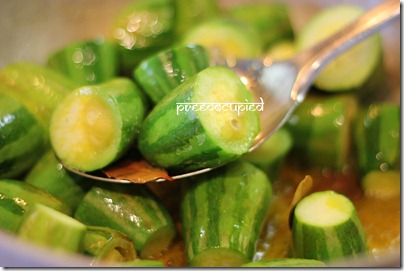

Add the mustard-poppy-green chilli paste to the potol and mix well till the vegetables get coated with the paste. Reduce the heat and cover again.
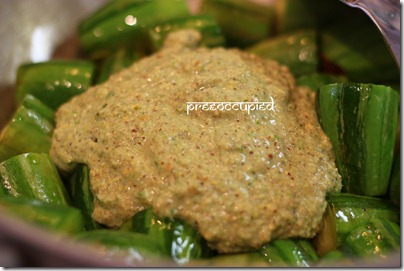
After about 4-5 minutes, add the coconut paste. Give it a good mix, cover and cook for about five more minutes.


The moisture from the wet ground ingredients will help soften the potols. Make sure you keep scraping the spices from the bottom of the pan, else they may burn.
Once the potol has cooked, add the sugar and salt. Cook uncovered till the extra moisture evaporates and the spices and the coconut cling on to the potol.

 Do one last taste test and season with more salt and sugar if necessary. You can throw in a couple of broken green chillies to add some more heat or leave the dish as it is. I did not add any turmeric to my dish. Just because I wanted the natural colors of all the ingredients to show. You can, if you want to.
An accent-deaf Bengali would eat this Shorshe-Narkel-Potol with mushurir dal and rice. And maybe a rui maach bhaja on the side.


