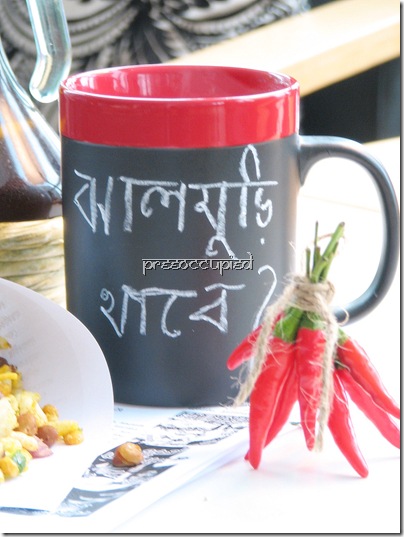
My beliefs as a pre-teen were mostly based on fantasy. I made myself believe that I could live happily ever after with a Jhalmuri wala from our neighborhood. He was young, wore a clean dhuti, skinny, and most importantly, not married. He also whisked out the best Jhalmuri in town. His hands worked magic with the ingredients on his push cart. Chopping, cutting, mixing and tossing an array of items in a steel can, sizzling it all up with lavish drops of mustard oil and finishing off each serving with finely chopped fresh coriander. Perfection was his persona. And I was in awe.

One day I told my Mother about my infatuation. I was all about 13, and learnt the word “entrepreneur” in English class. I realized it perfectly fit the description of my street-food crush.
Mother was slow to react to my precociously coherent longing of an entrepreneur jamai for her. Then one day she freaked out when she realized that I had given two measly pieces of sondesh to my crush. Things were escalated to my Father, who said he had lost all hope in me. He also feared I would elope with that fellow. That day I saw a look of dejected sadness on his face. With her cold, stony silence, even my little sister made me realize I was the family pariah and had no business either eating or longing for “junk”. Let alone marry one. My Dida said all this was bad for my health!
Today, I am happily married to a man who is neither an entrepreneur nor a jhalmuri wala. But loves this Calcutta street food with as much passion as I do. Much of our long-distance courtship was spent in talking about whether I knew how to make Jhalmuri, and if I could do it in Canada for my deprived fiancé.
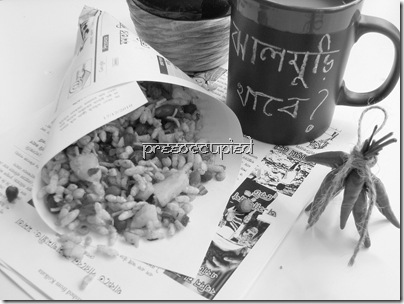 Bengali cuisine is never complete without talking about Jhalmuri. Puffed rice has never been treated with so much respect and reverence, as it is in this anytime snack which has its origins in the streets of Bengal.
Mere handfuls of puffed rice (muri) is transformed into a perky bowl of intense flavors, often rapaciously devoured by anyone who can stomach some heat, some sour, some crunch and some raw shorshe tel (mustard oil).
 Ingredients for Jhalmuri are:
2-3 handfuls of puffed rice/ muri
2-3 handfuls of Chanachur/ jhal dalmut as per your preference (make sure it has peanuts)
1-2 tablespoons roasted gram
1-2 tablespoons boiled red gram/ lal chola
1 medium boiled potato, peeled, roughly chopped
1 small red onion, very finely chopped
2-3 tablespoons cucumber, finely chopped
3-4 green chilies, finely chopped (do not add if you are making for kids)
1-2 tablespoons coconut, finely chopped (I did not have it at home, and did not add in this recipe)
Handful of finely chopped fresh coriander
Lemon juice
Drizzle of mustard oil
Pinch of red chili powder
1 teaspoon bhaja moshla
Half teaspoon chaat masala
Black salt
 Keep your Jhalmuri station ready to avoid any last minute missing ingredients. I like to make little portions for individual persons based on their heat and spice quotients. The rule to Jhalmuri is to mix in the wet/raw ingredients in the end to prevent the muri from getting soggy and limp.

(If you are using muri which has been lying in your kitchen for some time and is not as crunchy as you’d like it to be, throw some in a bowl and microwave for under a minute to get its texture back.)

 Okay, so now mix together the chanachur and muri along with the roasted gram and give it a toss. Add the spices and mix well. Check the seasoning, if your chanachur is quite salty already, go easy on the black salt.
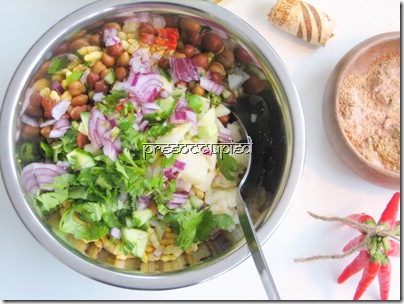
 Toss in the chopped onion, cucumber, boiled potato, red gram, green chilies, fresh coriander and few drops of mustard oil and lemon juice. Give it a good mix and serve immediately in paper cones or bowls. A cup of hot chai is most often enjoyed with this Jhalmuri. Make sure you share this with your friends, it just doubles up the whole experience.