Thursday, January 13, 2011

Oil-free Shami Kebabs, Well Almost

Shami Kebabs are probably one appetizer which has kept united Indian and the Mughal cuisines in every which way. These richly flavored, patty-shaped kebabs are traditionally made with soaked chana dal and shallow fried.

IMG_0693 But I was in a hurry to make them and also cater to some non-Indian palates. Hence I chose the oven-route, and used sattu instead of Bengal gram. Baking them in the oven also meant very little oil. Something men and women all over the world are so cautious about.

IMG_0695

Ingredients for Shami Kebabs are:

500 mince meat (lamb/goat/beef)
2 eggs
1 small red onion, very finely chopped
4-5 cloves of garlic, minced
1 inch root ginger, minced
5-6 green chilies, minced
Handful of fresh coriander, very finely chopped
Half a teaspoon of freshly ground garam masala
1 teaspoon red chili powder
1 teaspoon coriander powder
1 teaspoon cumin powder
10 whole black peppercorns
2-3 tablespoons sattu
2 tablespoons Canola oil
Salt

In a large mixing bowl, pound together everything except the oil.
IMG_0686
Take lime-size balls of the meat mixture and flatten them between the palms of your hands. Makes about 15-17 kebabs.
IMG_0689

Pre-heat oven to 350° F. Line a baking tray with aluminum foil. Place the kebabs on the tray and drizzle the oil, few drops on each.
IMG_0687
Bake these for 30-35 minutes, turning them at the halfway mark. Alternatively, you can shallow fry them in a hot pan till the meat is cooked through.

IMG_0696

Serve with fresh coriander chutney, hummus, slices of onions, and lemon wedges. I like mine with these non-heat, deep fried green chilies.
IMG_0700IMG_0711 IMG_0703
Also, the winner of my Blog’s first birthday giveaway is Aipi, the desi cook in an American kitchen! Thank you for coming to my party, Aipi. 38 

P.S. More kebab recipes and pictures from PreeOccupied are here.

Monday, January 10, 2011

Nolen Gurer Payesh

Friday is Sankranti, which means its time to get Nolen/ Notun/Khejur Gur and keep a flickering tradition alive. The winter sun is at its glorious best today, it reminds me of my younger days in India, when my parents would get this famous date jaggery, Bengalis lovingly call Nolen Gur.

IMG_0630 We would wait in anticipation when my Grandmother and Mum would get busy in the kitchen, breaking the gur down for sweet winter delicacies - pithe, puli, and payesh. All that is a thing of the past for me now.

What remains now, is just a taste in my mouth, and thankfully its not bitter. Its the smoky, sweet taste of Khejur Gur.

All I have today is a bowl of Nolen Gurer Payesh sparkling in the afternoon sun to remember my past and some forgotten traditions. And I’d like to share it with you…

IMG_0625

Ingredients for Nolen Gurer Payesh:

1 liter half and half cream/full cream milk
3 tablespoons Basmati rice, washed and soaked in water
6-7 tablespoons of grated date jaggery/ nolen gur

Begin by doing this test. Boil half a cup of milk and add some nolen gur in it. If the milk curdles, you cannot use that jaggery for your dessert. If it doesn’t you are in for some treat.

IMG_0609IMG_0613

In a thick bottom saucepan, boil the milk on low-medium heat, stirring continuously. When its reduced to half its original quantity, add the Nolen Gur. I grate my jaggery and then add it to the milk. It helps to quickly break it down in the hot milk.

Keep cooking the milk and gur by adjusting the heat from time to time. You literally have to babysit the cooking process. The last thing you want is to burn the milk and your precious gur.

When the milk starts to thicken, add the washed and drained rice.

IMG_0624 Keep the heat on low and keep stirring all the time. Scrape the sides of the pan into the milk, if a skin forms on the top, mix that in as well, the real taste lies there!

Do a taste test and add a little more gur only if necessary. Remember all food tastes less sweet (or salty) when they are piping hot. Do not overdo the sweetness in the payesh, no one likes a sinfully sweet payesh.

IMG_0617 When the rice in the payesh gets cooked, turn the heat off. The milk would have turned thick and adorn a color so rich, only Nolen Gur can flaunt!

Its now time to escape to the taste of tradition with a bowl of Nolen Gurer Payesh.
IMG_0628IMG_0632

Its also legal to make Payesh with plain white sugar. Here is the recipe if you don’t have Nolen Gur this winter.

Friday, January 07, 2011

Garlic Hummus

It helps when your mother-in-law to-be and you live in the same city. It gets even better when the son lives in far away Canada, which means that you get the undivided attention of his Mother.

Almost every weekend, before I got married to P, my Mum-in-law would make sure she would send me home-cooked food from their place to mine. This was in Delhi. Among her favorite things to send would be a jar of freshly made Garlic Hummus which she learnt many years ago during their stay in the Middle East.

IMG_0533I got so hooked to her Garlic Hummus, that I would eat it with everything. Including slices of toasted bread. Before my jar of Ma’s Hummus got over, she would make more and send through someone or bring it herself. I also think she did not mind a prospective daughter-in-law with garlic breath, as long as the garlic was from her Hummus.

IMG_0548 I have learnt to make Ma’s Garlic Hummus, and find it an easy dip for finger food of freshly cut vegetables like carrots, celery, broccoli, etc.

Ingredients for Garlic Hummus are:

2 cups cooked chickpeas, retain a little water its boiled in
3 tablespoons white sesame seeds, lightly roasted
4-5 garlic cloves
Juice of one lemon
Pinch of cayenne pepper
Sprig of fresh parsley
Quarter cup + 1 tablespoon extra virgin olive oil
Salt

Traditionally, Tahini is used in Hummus, but if you don’t have it, use roasted sesame seeds like I do.

Start by breaking down the sesame seeds in a blender. Then add the chickpeas, garlic, EVOO and lemon juice and give it a good whoosh, till you get a thick, smooth consistency. You can add spoonfuls of the water you have retained from cooking the chickpeas to get the right consistency of the Hummus.

IMG_0534 IMG_0541 Do a taste test and see if you need any salt. Season accordingly.

Just before serving, drizzle a little more of the EVOO, a generous pinch of chopped fresh parsley and cayenne pepper on the Hummus. You can use it as a spread between your pita bread or roti, or just as a freshly made dip for breadsticks, vegetables or kebabs.
IMG_0550 IMG_0547IMG_0554

The Hummus bowl that you see here is something I made at Pottery School, I had in mind the “Middle East” and my hands just followed my mind.

IMG_0514IMG_0515

More pictures of my Pottery Work is here.

Thursday, January 06, 2011

How Pabda Got Discussed, Got Cooked, and Got a Life

I am amazed and humbled, both at the same time how one little question can bring a veritable treasure trove of family recipes tumbling down from nooks and corners of the world. I am talking about several Pabda (Butter Catfish) recipes that readers and friends of PreeOccupied shared today. All I can do is, assure you that it will take you many Pabda sojourns to be able to make all of these recipes. I am so glad I am able to share them with you today. IMG_0482
Mala Ray Chatterjee
of Hyderabad, India, shared a simple jhol with kalo jeere (Nigella seeds), green chilies cooked in a gravy of turmeric, salt and some freshly chopped coriander. I had all the ingredients at home and so I went on to make Mala’s Pabda Maacher Jhol. The only change I did make was to add a little grated ginger to my jhol and added red chili powder too the thin gravy of turmeric and salt where the fish got dunked in. IMG_0491IMG_0497
Subharsee Basu
of Bombay was confident that adding a clove of garlic to the mustard paste base would take the taste of the Pabda Maach a notch or two above the ordinary.

IMG_0486IMG_0488
Purba Mitra
suggested a phoron of Nigella seeds and green chilies in hot oil to start with, followed by the fish to be cooked in a sauce made of yellow mustard seeds and poppy seeds. Adding fresh coriander in the end is a necessity – both flavor-wise and aesthetically. IMG_0494
While Amarnath Chatterjee of Japan who calls his recipe of Pabda, Dum ki Machili typed out a detailed recipe I am copy-pasting here: Try a yogurt, green chili paste thing....sauté some cloves, one black cardamom with some caraway, add ground onion paste, brown, add ginger garlic, fry, add holud, red chili powder then add 1- 2 cups yogurt and 8-10 green chilies turned paste, cook till thickish, slip in the fish, simmer uncovered till done...IMG_0496
Pritha Dutta
of Delhi who had once shared her Mother’s stuffed Kankrol recipe had another ace up her sleeve. She bowled us over with her Mother’s un-patented Tomato Pabda. Here is the recipe: Shallow fry the fish. For a kilo of pabda, you will need about two tablespoons of onion paste, one teaspoon each of green chili, ginger and garlic paste, two bay leaves, 3-4 cloves, 3-4 large ripe tomatoes, ghee and Bengali garam masala. Blanch the tomatoes in hot water, remove skin and grind into a paste. Heat ghee, add bay leaves and cloves, onion, green chili, ginger and garlic pastes. Once the masala starts to leave the sides, add tomato paste, salt and sugar to taste, garam masala and some water. Add the fish, cook covered for about 3-4 minutes. Gently turn the fish. Cook for another minute, remove from heat. Garnish with slit green chilies. Serve with steaming fluffy white rice.

Ronita Biswas adds that adding a little drizzle of raw mustard oil (kancha shorsher tel) to the cooked Pabda Maach curry adds a whole lot of zing to the dish. Point noted, Ronita.

Prem Chowdhury of Virginia, USA, recounted how his Dida taught him a Paturi recipe with Pabda. He adds that the recipe just has onions and red chilies and is lip smacking good. One day soon, we will have Prem write out his Grandmother’s gem. And cook it too.
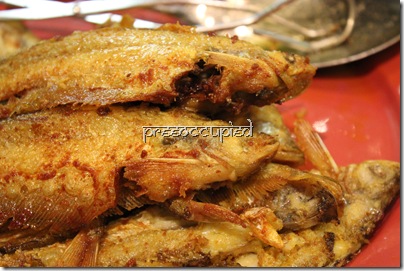
IMG_0490

Two ladies by the same name answered the Pabda calling, both painstakingly detailed out their respective recipes.

Sumana Sen-Bagchee of Edmonton, Canada, whose aunt’s bitter gourd recipe was an instant hit with the readers of my Blog has this to say: Pabda can be done very simply too--with kalo jeerey or panch phoron. Lightly fry the fish if they are frozen. Mix in a small owl halud-dhoney and lanka powder with some water. After adding phoron and kancha lanka to the oil pour in the liquid, carefully, thin it if needed, let it come to a boil, add a few pieces of chopped tomatoes, cook a while covered. Salt it, Slip in the fish when the gravy looks nicely cooked, the tomatoes married, add some grated ginger, cover and cook till fish are cooked. Sprinkle a little mustard oil, my mojo for all Bengali food, sprinkle with chopped coriander. My mom-in-laws recipe: Pabda from Pabna.

Sumana Raychaudhuri of Maryland, USA, says her favorite Pabda recipe is a simple curry made with ginger and green chili paste. Here is her recipe: pre-frying the fish is optional.
Soak two inches of fresh ginger (after peeling) and three red chilies (for 5-6 medium size fish) in water for few hours and make a coarse paste with the same water. Soak two large tomatoes in hot water and remove the peel. Now make a smooth paste with ginger-red chili-tomato. Heat oil, add kalo jeera, green chili and the ginger-red chili-tomato paste. Add salt and turmeric. Boil once, add the fish and wait till the fish gets cooked. Garnish with dhonepata.

IMG_0501
The conversation around Pabda Maach had just begun…

With so many recipes shared and discussed over a period of less than a few hours, I was left confused and lusting for all of them. I chose one and got inspired by the rest of them. I shall leave you now with the pictures from my kitchen on this unique Pabda journey. I know you will get this silver-colored buttery fish the next time you are in a maacher bajaar, and cook at least one of these little gems shared by all the wonderful people.

IMG_0502 IMG_0509
IMG_0510

Wednesday, January 05, 2011

Give Peas a Chance!

A couple of weeks ago at Pottery School, when I had some extra clay which was fast turning too hard to work with, I made this “Peas in the Pod”. Thinking it’d make a pretty display for my countertop.

IMG_0477 I rolled three balls in different sizes. I cut a rectangular slab and ran the pin tool very unevenly on the sides. Then I kept the three peas at the center of the slab and raised the side walls with my fingers. Of course I “slipped and scored” each “pea” to the “pod”.

IMG_0476 It was left to dry for a week and then my teacher bisque-fired it. I used a green underglaze to paint it. Lastly I used a transparent lead-free glaze on top.

IMG_0475

It was again fired in the kiln. What you see is twice fired Peas in the Pod! What do you think?

IMG_0479 IMG_0478

While we are on the subject of my favorite vegetable I lovingly called “Poto” as a kid, please see my peas recipes too. They have real peas in them!

Peas, pretty peas!

Monday, January 03, 2011

Koi Maacher Jhaal

There is an old Bengali saying that the power of endurance of a woman is like a Koi fish’s (Climbing Perch).

May manush’er praan, Koi maacher jaan!

Meaning both the Koi and a woman have great abilities to withstand pain. Try clubbing a live Koi for your meal and you will see how it takes you four or five, even more times to beat it to death! Koi is a pond fish, often found in slushy inlets, quietly hiding from a predator or fisherman. It has a dark appearance, the skin is rather thick. Koi fish is sweet, fleshy and has hook-like bones. I have once suffered the pain a Koi bone can cause to the throat, while eating a delicious curry made with mustard and green chilies, often called a Jhaal in Bangla.  IMG_0371
The Koi we eat should not be confused with the Japanese ornamental brocaded ones by the same name.

So today’s lunch was this Koi Maacher Jhaal, a simple mustardy curry spiked with fresh green chilies. IMG_0355

Ingredients for Koi Maacher Jhaal are:

500 grams Koi fish, washed and cleaned
2 medium size ripe tomatoes, quartered
6-7 green chilies, slit lengthwise
Handful of fresh coriander, finely chopped
3 heaped teaspoons of freshly ground yellow mustard
Three-fourth teaspoons red chili powder
2 + 1 teaspoons turmeric powder
Half cup mustard oil
Salt

Heat mustard oil in a wok/thick pan until smoking. Rub two teaspoons turmeric and a spoonful of salt to the fish and shallow fry them, about two minutes on each side. Remove with a slotted spoon and keep.

IMG_0351 IMG_0349
In the remaining oil, add the tomatoes and green chilies and sauté for a minute or two. In a bowl, mix together the mustard, turmeric, and red chili powder. Add three cups of water and add the mixture to the tomato-green chili in the pan. Season with salt.IMG_0356

IMG_0359 Let this cook on medium-high flame for about 7-8 minutes, till the tomatoes and the spices are cooked through. Now gently release the Koi fish, holding them by their tails!

IMG_0363 It takes about 4-5 minutes after you release the fish into the mustard curry to complete cooking. Don’t forget to turn the fish in the sauce. Finish with a generous garnish of chopped coriander. The Koi Maacher Jhaal is recommended with steaming hot rice. Enjoy!

IMG_0367 IMG_0374Oh and just so you know, I did not have to club a Koi to death, it was available at the Bangladeshi store we get our share of desi fish from.